LED chips and power supplies for signs determine brightness, colour consistency, operating stability and service life. A brand name alone does not show whether the exact series, bin or batch in your sign will perform.
What predicts performance. Measured output, colour-temperature consistency, lumen maintenance, module and driver design, and batch stability.
Specifications for LED chips and power supplies for signs should use recognized terminology and test methods. For standardized LED lumen-maintenance references, consult the Illuminating Engineering Society standards catalog.
What to verify. The exact model and spec sheet for your components, plus the test method and pass criteria behind every figure you are shown.
Who this is for. Sign companies and brand teams specifying LED and power-supply components. Distributors and installers will find the same criteria useful, though documentation needs differ.
About the manufacturer. Hicen manufactures channel letters, LED light boxes, LED neon signs and metal signage in Dongguan, China. Company facts below come from our own manufacturing process, quality control and product pages, checked 6 August 2026. Confirm anything you rely on before you order.
How LED Chips and Power Supplies for Signs Are Selected
Selection follows a sequence, not a brand pick. Environment and duty cycle first. Then your photometric target, then module selection matched to it, then a thermal and voltage-drop check across your wiring layout, then power-supply sizing with margin above your calculated load, then a sample and your approval, then batch production. A quote that jumps from your logo file straight to a price has skipped this sequence.
9 Critical LED Chip Parameters to Check
Ask for each of these against a model number.
| Parameter | Why it matters | Evidence to request |
|---|---|---|
| Luminous flux and efficacy | Output per chip and output per watt, which drives both brightness and heat load | Manufacturer datasheet at the drive current you are actually using |
| Drive current and forward voltage | Chips are binned and rated at a stated current. Running them harder changes everything downstream | The specified drive current, and the module's design current |
| CCT consistency and binning | Whether letters match each other, and whether a reorder matches the first batch | The bin or SDCM tolerance, not just a Kelvin number |
| CRI | How accurately the light renders a brand colour | The stated CRI at your CCT |
| Junction temperature and thermal resistance | The single biggest driver of real service life | The rated maximum junction temperature and the module's thermal path |
| Lumen maintenance | Output retained over life. LM-80 measures lumen and colour maintenance for packages, arrays or modules, and TM-21 projects long-term maintenance from that data. Neither is a finished-sign lifetime warranty | The LM-80 report and TM-21 projection for your chip, from the chip maker |
| Module operating temperature | Whether the assembly survives your climate, not just the chip | The module's rated ambient range |
| Batch stability | Whether the supplier reproduces the spec order after order, not only on your approved sample | Lot IDs and incoming-inspection records |
A power-on burn-in test, ours runs 48 hours, screens for early failures and confirms initial brightness. It does not establish rated lifespan or lumen maintenance. Ask the chip manufacturer's datasheet for that, and read our signage service life guide for how those figures translate to a finished sign.
We offer pure white, warm white and RGB. Ask for the chip spec sheet for your configuration, including CCT tolerance and CRI.
Module Design Matters Just as Much
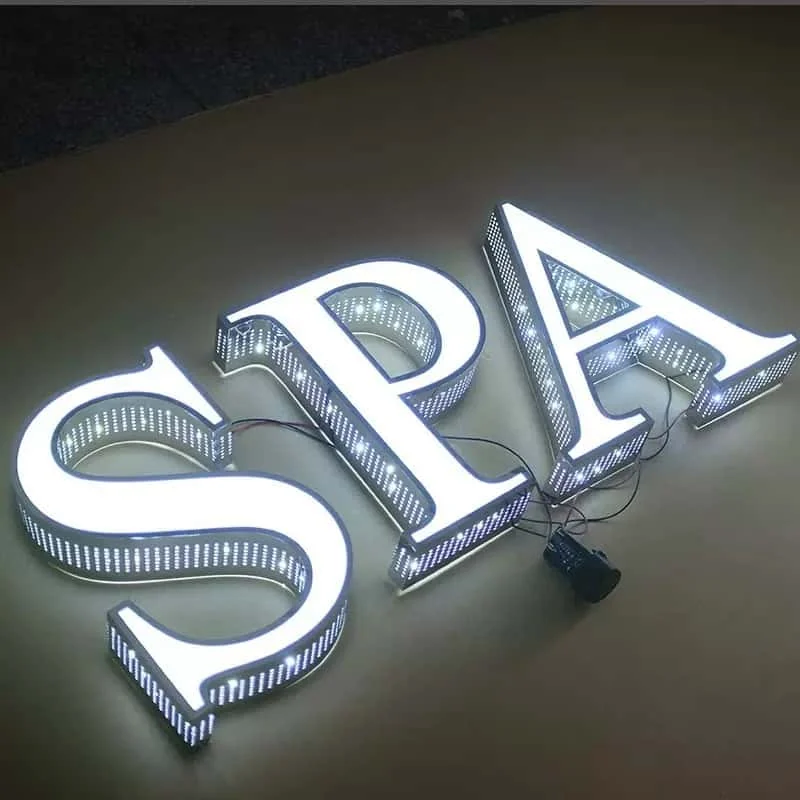
Optics. The lens shapes how light spreads. The wrong angle for your letter depth creates hot spots.
Thermal design. The PCB moves heat away from the chip. Poor thermal design shortens chip life even with a good chip.
Sealing. Module-level sealing limits water and dust ingress around the chip and driver, not just the outer shell. Ask for the IP rating and the test scope rather than the word "waterproof".
Wiring. Gauge and connector quality affect voltage drop on a long run. That shows up as dimmer letters at the far end.
Spacing. LED density decides even illumination versus visible hot spots, especially on deeper letters.
Depending on the product line and design, configurations may use 12 V or 24 V LED modules, and our light box page also lists 110 V and 220 V options. Confirm the module voltage and power-supply series in the approved bill of materials for your order.
Our LED light box page publishes a face luminance range of 400 to 1200 cd/m² with over 95% illumination uniformity. Read those as design-dependent examples, not a guarantee. Face luminance is the sign's visible brightness, not the chip's own output, and both figures shift with depth, diffuser and LED spacing. Ask which measurement distance, grid, sample size and uniformity formula sit behind them, and the acceptance threshold for your design. Our guide to light sources for acrylic glowing signs covers how source choice changes that result.
The Power Supply Decides Stability
Headroom. Size margin from the manufacturer's derating and lifetime curves for your ambient and case temperature, not from a fixed percentage. Thermal stress depends on ventilation, mounting and enclosure design as much as on load.

Efficiency. This affects how much heat the driver generates inside an enclosed housing.
Protection. Over-voltage, over-current, short-circuit and thermal shutdown keep one fault from taking down the whole sign. Ask which your unit includes.
Power Supply Specification Checklist
| Specification | What to ask for |
|---|---|
| Rated ambient and case temperature | The stated range, and the Tc measurement point on the unit |
| Derating curve | Output allowed at your actual ambient temperature |
| Rated lifetime | Hours at a stated Tc and load, not a headline number |
| Output ripple and flicker | Relevant if the sign appears on camera |
| Power factor and THD | Often required by the destination market's utility or code |
| Surge capability | The rated surge level for your installation |
| Location and IP rating | Whether the driver is rated for the enclosure it will sit in |
| Safety approvals | The applicable approval, with file or report number |
We test each power supply under full load for four consecutive hours, tracking temperature rise and voltage stability. Ask us to confirm the actual driver series and model for your order in the quotation and bill of materials.
Brand Does Not Guarantee Fit
One brand sells multiple series with different voltage ratings, waterproof levels and rated lifespans. A driver rated for indoor use fails outdoors, however reputable the brand. Match the component to your voltage, environment and expected service life, then confirm the datasheet covers those requirements.
Buying Conditions That Change the Requirements
| Condition | Ask about | Evidence to request |
|---|---|---|
| Outdoor façade | IP rating and UV-resistant materials | An IP test report scoped to the assembly |
| Coastal site | Corrosion protection on housings and fasteners | Material grade, coating system, salt-spray data |
| Rooftop mounting | Temperature swings and direct sun | Thermal cycling tolerance at seals |
| Cold climate | The driver's rated operating range | The power supply's stated ambient range |
| Long wiring run | Voltage drop across your run length | A voltage-drop calculation for your layout |
| Dimming or RGB | Driver and module compatibility with your control method | Written confirmation before you order |
Tell us your exact condition and we will tell you what changes.
Substitutions, Traceability and Warranty
Ask whether a component substitution needs your written approval, and how a substitute gets validated against your approved sample. Ask how batches trace: lot IDs for chips, modules and drivers, incoming-inspection records, and finished-unit records mapped to your purchase order.
Get warranty terms in writing. Our light box page publishes a one-year warranty on the complete unit and five years on the LED light source, so check what applies to your product line. Confirm who diagnoses a failure, what counts as evidence, what is excluded, and who covers return shipping. A general reliability claim is not a warranty.
How to Verify Our Manufacturing and QC
We manufacture housings, back panels and acrylic faces in-house, and assemble and test LED modules on our own lines in a 20,000 square metre facility in Dongguan. Check the current figures on our company profile.
Quality control runs five stages: incoming material inspection, in-process patrol, semi-finished sampling, finished-product inspection, and a final recheck before packing. Incoming checks cover metal thickness, LED brightness uniformity, outdoor-grade coatings and acrylic light transmission. Tolerance varies by process, material and geometry, so ask for the figure that governs your part on the approved drawing.
Compliance documentation is not interchangeable.
ISO 9001 certifies our quality-management system, not any individual sign.
CE marking is not a certificate issued by a central EU authority. Where applicable EU legislation requires it, the manufacturer completes the conformity assessment, prepares technical documentation, issues an EU Declaration of Conformity and affixes the marking. Ask which legislation, standards, models and configurations the declaration covers.
UL distinguishes a Listed finished product intended for field installation from a Recognized Component intended for use inside a certified end product, which carries Conditions of Acceptability. Ask whether the claim covers the finished sign or a component, and for the model or category, file number, location rating and conditions.
RoHS is substance-restriction compliance tied to your bill of materials, not a certificate.
SGS provides testing, inspection and certification services. The name alone does not tell you what was evaluated, so ask for the report or certificate number, the product and model scope, the test standard, the issue date and validity status.
We supply product-level documentation for your configuration. Installation permits and local code compliance stay with you, your installer or your local authority.
What to Send and What to Request
Send with your enquiry
Application: indoor or outdoor use, viewing distance, mounting height, climate, expected service life
Design files: vector logo, font outlines, colour codes, dimensions, reference image
Installation conditions: wall material, space behind the wall, power location, local restrictions
Technical requirements: target market and certifications, voltage and frequency, ambient range, control method
Commercial and acceptance terms: quantity, delivery date, Incoterm, destination postal code, sample plan, warranty scope
Request from the supplier
Model number and full spec sheet for the LED chips and the power supply, not a brand name
The test method, sampling plan and pass threshold behind any figure
Certificate or report number, issuing body, covered products and validity dates
Aging and load-test results tied to your production batch
The substitution and traceability process, in writing
Expect general specifications at enquiry and batch-specific results closer to production and shipment. Share only what an accurate quote requires, since a site address and photos can carry sensitive information.
What This Means for Your Project
LED chips and power supplies for signs perform reliably when three factors align: measured parameters and batch stability rather than the brand on the datasheet, module-level design rather than the chip alone, and a driver sized with real headroom for the actual load and environment.
Send us your project brief and we will come back with a recommended LED and power-supply series, a load calculation, the compliance documents that apply, a sample plan and a quotation. Your installer or local engineer should confirm installation and code requirements. Talk to us about your project, or compare options first in our channel letter selection guide and signage cost guide.
FAQs
What should I confirm first about LED chip parameters?
The spec sheet behind the brand name. Ask for luminous flux and efficacy at your drive current, CCT binning tolerance, CRI, rated junction temperature and lumen maintenance, plus the test method behind each figure.
Does a 48-hour burn-in prove the rated lifespan?
No. A burn-in screens for early failures and confirms initial brightness. Rated life comes from the chip maker's LM-80 data and the TM-21 projection built on it, and neither of those is a warranty on the finished sign.
How can a manufacturer prove its power-supply quality?
Ask for the exact series and datasheet, the derating and lifetime curves, the protection features, and load-test results tied to your batch. A brand endorsement or a test duration on its own proves nothing.

What should I send before requesting a quote?
Application details, design files, installation conditions, technical requirements, and commercial and acceptance terms. Sending all five usually gets you a specification-matched quote on the first pass instead of a price alone.