
If you’re specifying a hurricane-resistant digital pylon, base the design on the governing RFP, the locally applicable building code, your project’s actual design wind speed, exposure category, risk category, site elevation and geotechnical data, then have a qualified structural engineer calculate the frame, connections, anchorage and foundation from those numbers. “Category 5” on its own isn’t something a structural engineer can calculate against. It’s a storm-intensity classification, not a design wind speed, and treating the two as interchangeable is where hurricane-resistant sign designs start to go wrong before a single member is sized.
Here’s how to convert your site’s wind environment into a structural design you can actually review, instead of a spec sheet that just repeats “Category 5” and hopes that covers it.
Confirm the Design Basis
Category 5 comes from the Saffir-Simpson scale, which classifies a storm’s sustained wind speed. It isn’t the design wind speed your structural engineer plugs into a code-based calculation, and it doesn’t tell you the exposure category, risk category, or site elevation your engineer needs to run the numbers. Two Category 5 storms can produce very different design pressures on your specific pylon depending on where the site actually sits.
Before any structural work starts, confirm these directly from the governing RFP and your local building authority:
- The project’s actual design wind speed, in the units your applicable code uses
- Exposure category for the site, since terrain and surrounding structures change how wind loads the sign
- Risk category assigned to the structure, which affects the safety factor applied to the design
- Site elevation and any local amplification factors
- Geotechnical data for the foundation soil conditions
If a supplier’s proposal says “hurricane-resistant” or “rated for Category 5” without naming the actual design wind speed and the code it was calculated against, that’s not a design basis. It’s a marketing line standing in for one, and you should ask for the number before you go further. A prime contractor coordinating your project’s engineering should be able to state this basis plainly, not gesture at a storm category.
Analyze the Complete Load Path
Once the design basis is confirmed, the wind load has to be traced through every part of the structure that carries it, not just checked at the base.
LED cabinet faces. On a double-sided digital pylon, you effectively have two large sails catching wind from either direction, and wind pressure isn’t uniform across a cabinet face. Corner and edge zones typically see higher pressure than the center.
Support columns. The load from the cabinet transfers into the column as bending and shear, and column sizing has to account for the full cabinet area, not an assumed average.
Base plate and anchor bolts. This is where overturning moment converts into tension and compression on individual anchor bolts. Undersized anchorage is one of the more common failure points in sign structures, because it’s easy to size the column correctly and still get the anchor bolt pattern wrong.
Foundation. The foundation has to resist the overturning moment and lateral shear the anchor bolts deliver to it, sized against your actual geotechnical data rather than an assumed soil bearing value.
At each stage, your engineer should check overturning, sliding, member and connection strength, and deflection. Deflection matters more on a digital pylon than on a static sign, since excessive movement under wind load can affect LED module mounting and long-term connector fatigue, not just visible sway. Fatigue from repeated wind cycling over the structure’s service life is a separate check from the peak-load case, and both need to be run, not just the worst-case gust.
Design Fabrication-Ready Connections
A structural calculation that stops at “the connection is adequate” isn’t fabrication-ready. Welds, bolts, stiffeners and any modular splice connections need to be detailed on the drawings with sizes, patterns and specifications a fabricator can actually build to.
This matters more than usual on a large pylon, because these structures are often fabricated in sections and shipped, then assembled on site rather than erected as one welded piece. Ask directly whether your pylon will ship in one piece or split for freight, and if it’s split, get the splice connection details specifically. A splice joint needs to carry the same load the base member does. It’s not a lighter-duty connection just because it’s a field joint, and it’s one of the places a design can look sound on paper while quietly becoming the weakest point in the actual structure if the splice itself isn’t engineered to match.
Prepare Engineering Deliverables
Before fabrication starts, you should have a defined set of engineering deliverables in hand, not just an approved rendering:
- Structural calculations covering the full load path above
- Structural drawings a fabricator can build from directly
- Foundation reactions, handed to your site’s civil or geotechnical engineer to size the actual footing
- An anchor bolt template, so the foundation can be poured correctly before the structure arrives on site
Identify who holds professional-seal responsibility for the calculations and drawings, and in which jurisdiction that seal is valid. A stamp from an engineer licensed in one jurisdiction doesn’t automatically satisfy a different jurisdiction’s permit authority, so confirm local review and permitting requirements separately from the engineering itself. Build this into the same scope and interface matrix you’d use to coordinate the rest of a turnkey signage package, so foundation reactions, anchor templates and drawing sign-off each have a named owner and a due date rather than surfacing as a gap during fabrication. Confirm how your supplier documents drawing checks and dimensional verification against the approved design before production, similar to the drawing and dimensional checks described in Hicen’s quality control process, since a design that isn’t verified against the as-built drawing before fabrication starts is a design that can drift during production.

Suggested Visual
The diagram below summarizes the complete load chain a reviewer needs to see in one image rather than reading it out of a calculation package: wind pressure acting on the LED cabinet face, transferring through the support column, into the base plate, through the anchor bolts and finally into the foundation, with the ground reaction resisting overturning.
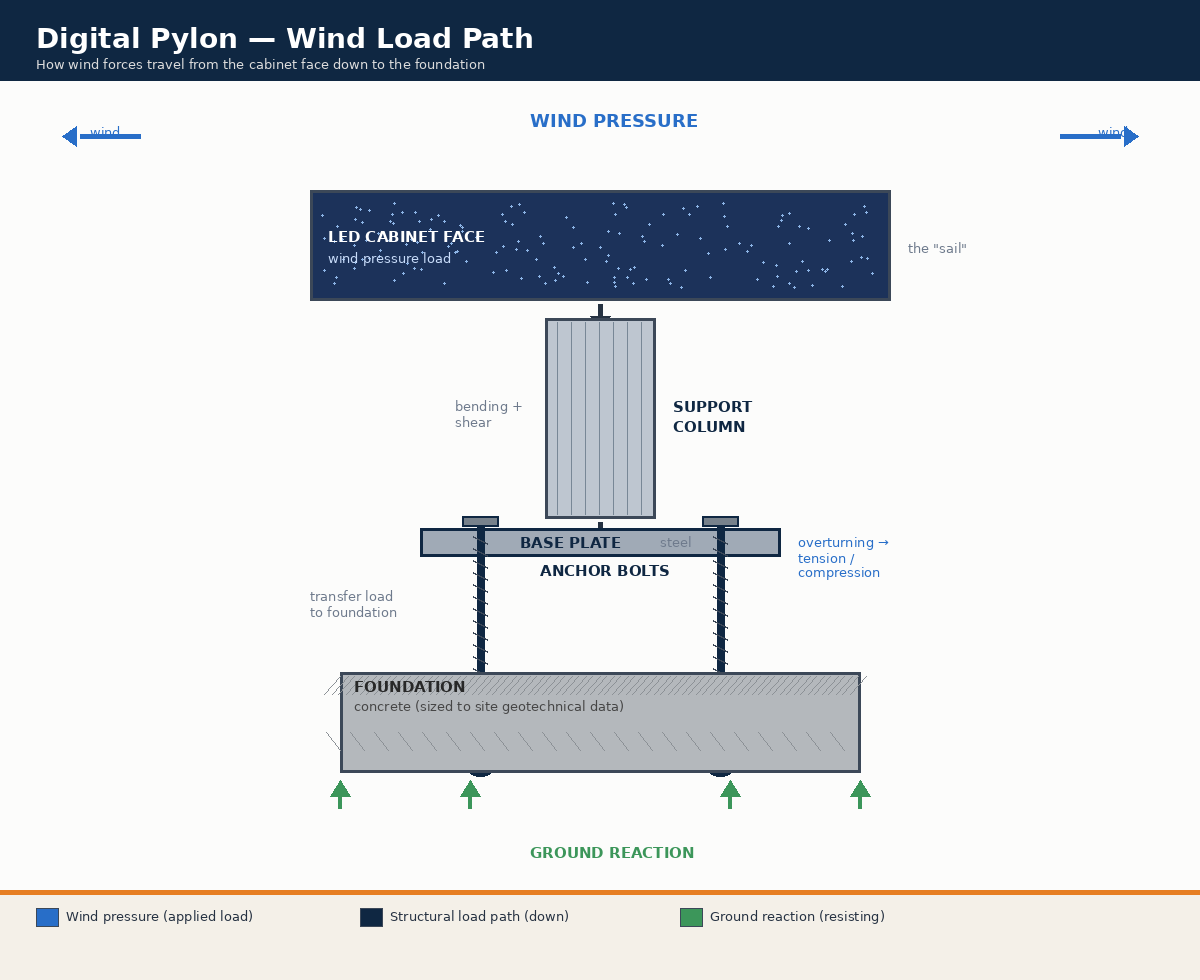
Reference schematic only. Actual loads, member sizes, anchor bolts, and foundation geometry depend on your project’s design wind speed, exposure category, risk category and geotechnical data.
Scope of This Guidance
This article explains what engineering inputs and deliverables a hurricane-resistant pylon design needs. It does not substitute for signed and sealed structural calculations from a licensed engineer in your project’s jurisdiction, and it does not state or imply a specific code requirement, since applicable codes vary by location. Confirm your governing code, permit process and professional-seal requirements with your local building authority and your engineer of record.
Start a High-Wind Design Review
Send us the structural clauses from your RFP and your site data, wind criteria, exposure, risk category, elevation and any geotechnical information you have, and we’ll start a design review against your project’s actual requirements rather than a general product spec.
Frequently Asked Questions
Does Category 5 equal one fixed design wind speed?
No. Category 5 is a Saffir-Simpson storm classification based on sustained wind speed, not a structural design wind speed. Your actual design wind speed comes from the applicable building code applied to your specific site, and it needs to be confirmed as a number, not assumed from the storm category alone.
Who is responsible for the sign foundation and geotechnical data?
This depends on how your contract assigns it, and it should be stated explicitly rather than assumed. In many projects, the geotechnical data and site civil design sit with the site’s own civil or geotechnical engineer, while the sign structural engineer provides the foundation reactions that engineer needs to size the footing. Name this responsibility in your scope matrix rather than leaving it implied.
Do LED ventilation openings affect wind-load analysis?
Yes. Vent openings change how wind pressure acts inside the cabinet, since a vented enclosure and a sealed enclosure don’t carry the same internal pressure coefficients in a wind-load calculation. Give your structural engineer the actual cabinet design, vents included, rather than a sealed-box assumption.
Can a standard pylon design be reused as-is for a hurricane-rated site?
Not without re-verification. A design calculated for a different wind speed, exposure category or risk category needs to be re-run against your site’s actual criteria. Reusing a standard design without that check is exactly the kind of substitution this article is arguing against.