Channel letters and cabinet signs are the two most common illuminated storefront sign types, and the choice between them shapes how your brand looks, how much you spend, and how the sign performs over its lifetime. Pick the wrong one and you either overpay for features you didn’t need or settle for a look that doesn’t match your brand.
What Is a Channel Letter?
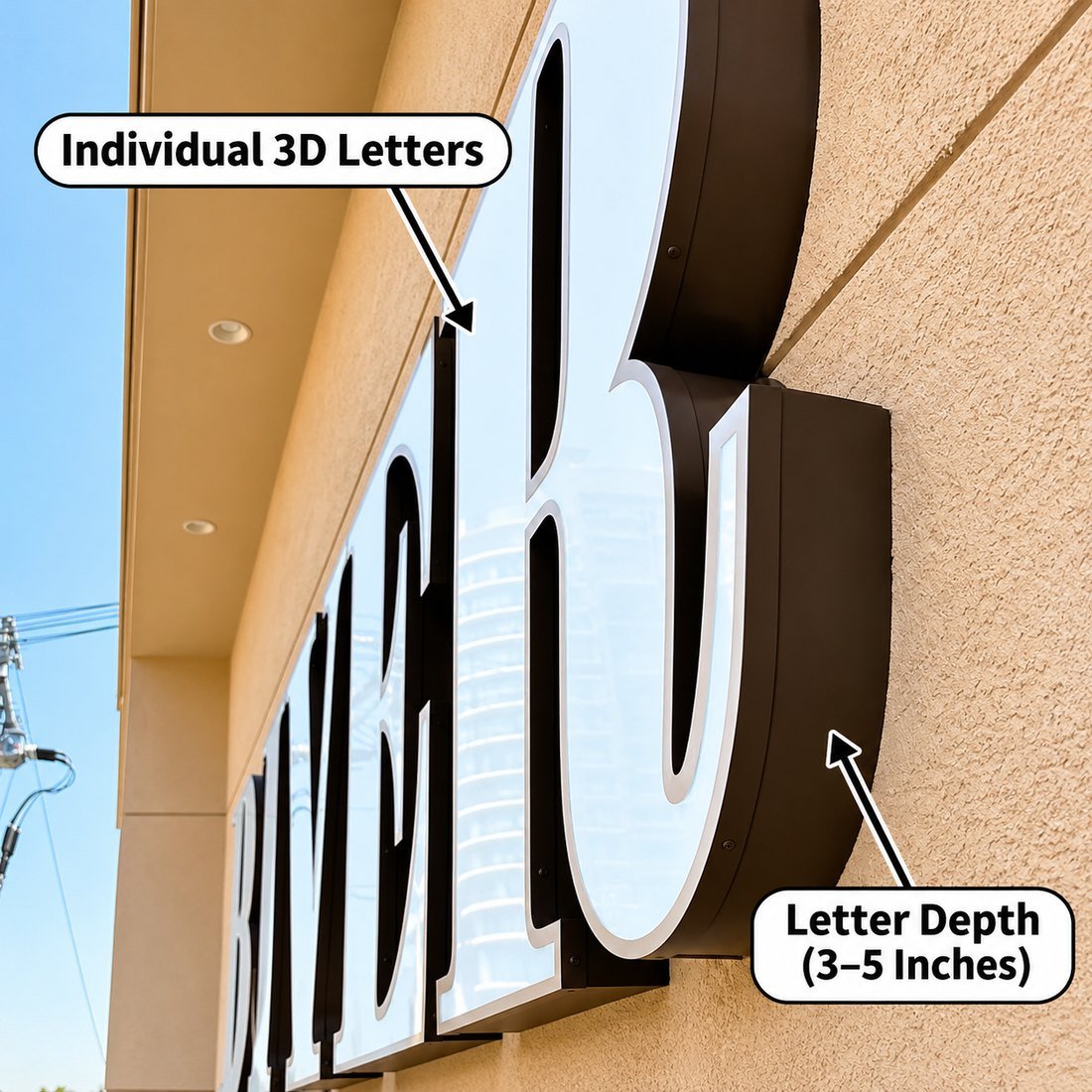
A channel letter is an individually fabricated three-dimensional letter or shape. Each piece has its own metal housing, the channel, a translucent face or backing, and its own LED module and wiring inside. The letters are mounted individually to the building wall, a raceway or a backer panel, and each one is its own self-contained sign element.
The word channel refers to the U-shaped metal return that forms the sides of the letter. That return is what gives the letter its depth, typically 3 to 5 inches, and it is what houses the LEDs and diffuses the light through the face material.
Depth is the whole point
That return is what you see from the side, and it is what the letter’s shadow is made of. A 3-inch return reads as a subtle step off the wall; a 5-inch return reads as a distinct object sitting on the building.
Letter returns commonly run about 3 to 5 inches deep at storefront letter sizes. Hicen’s channel letter line covers front-lit, halo-lit and combination-lit builds in aluminium, stainless steel and acrylic.
What Is a Cabinet Sign?
A cabinet sign, also called a light box sign or box sign, is a single enclosed unit with an illuminated face panel. Instead of individual letters, the entire sign is one structure. The cabinet is usually made from aluminium extrusion or sheet metal, and the face is a translucent panel printed or cut with your logo, text and graphics.
The face can be a single sheet of acrylic or polycarbonate, a flex-face fabric tensioned across the frame, or a panel with push-through letters for a dimensional effect. All the LEDs, wiring and power supply sit inside the one box.
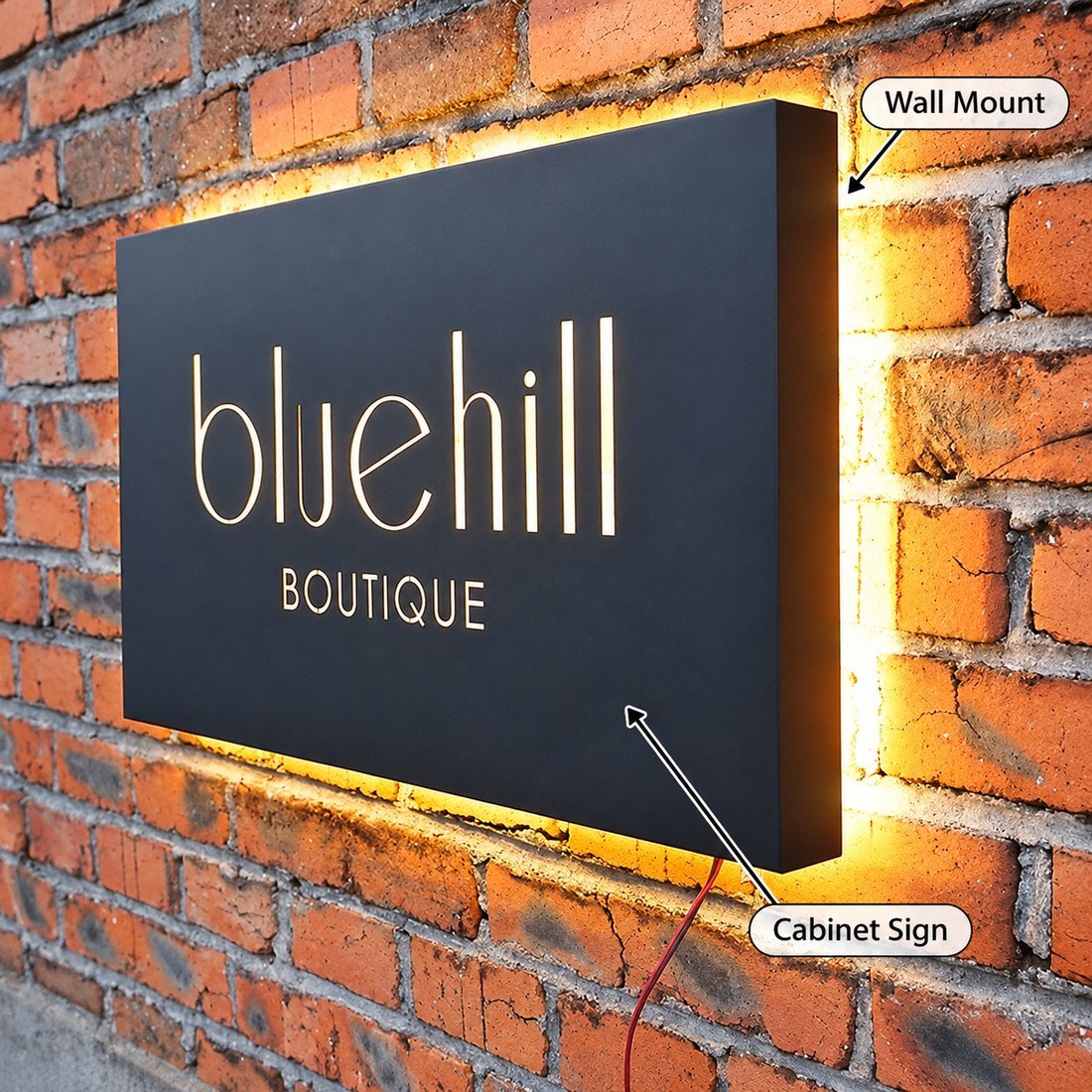
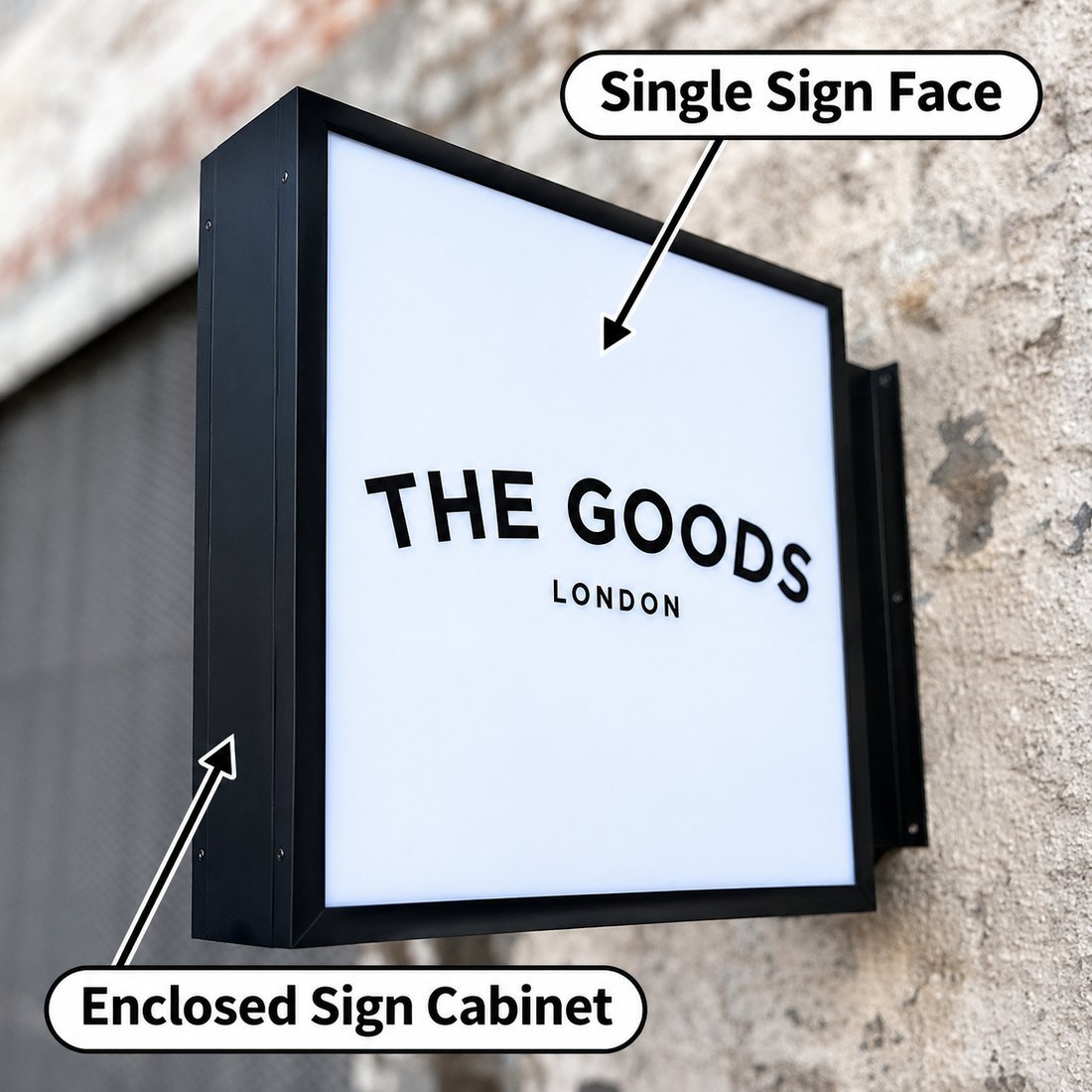
Hicen keeps standard frameless LED light box profiles in permanent stock, so a cabinet sign on a standard frame can ship faster than a fully custom build. The LED light box range covers magnetic and snap-open frame systems, so a face can be replaced without tools.
Side-by-Side Comparison
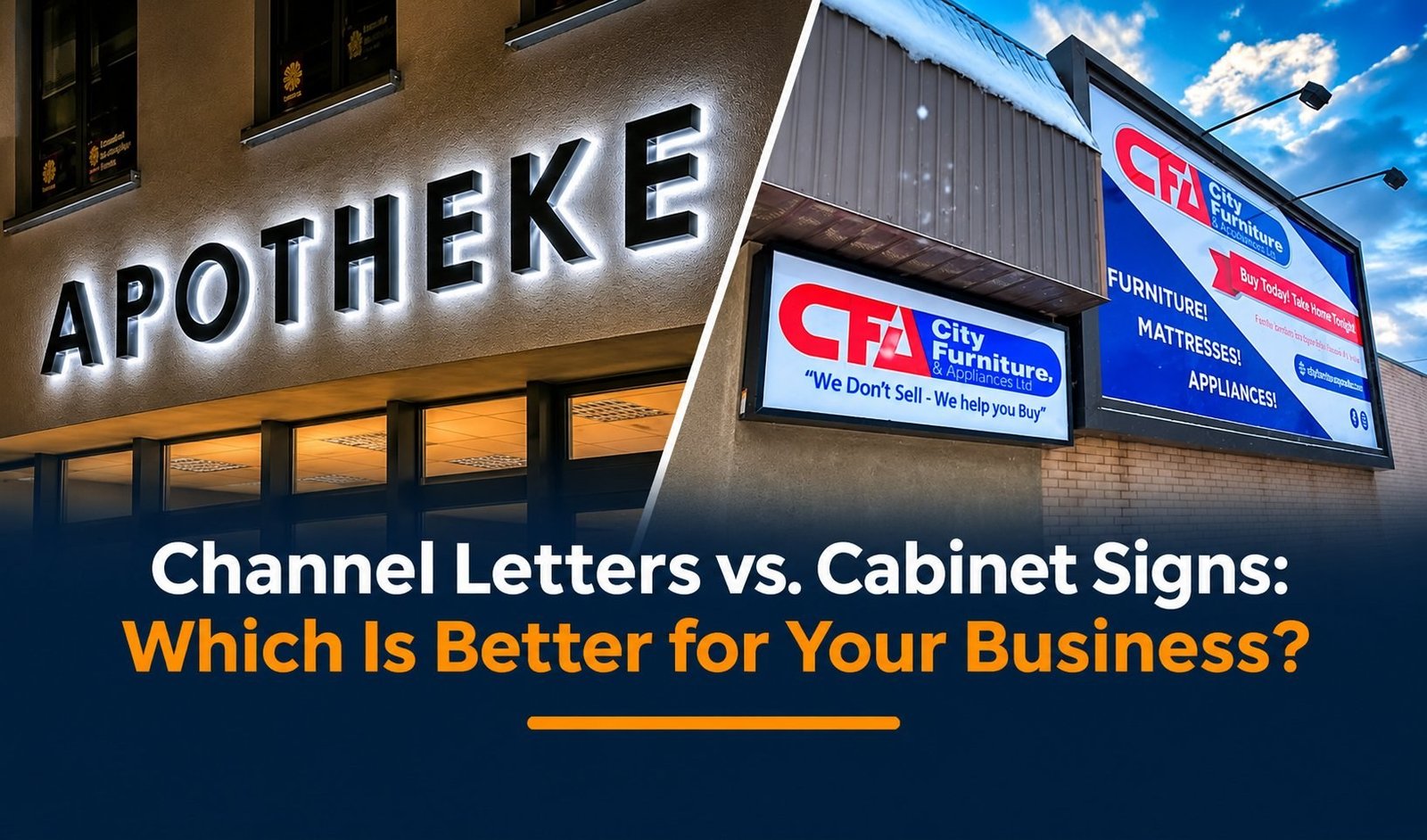
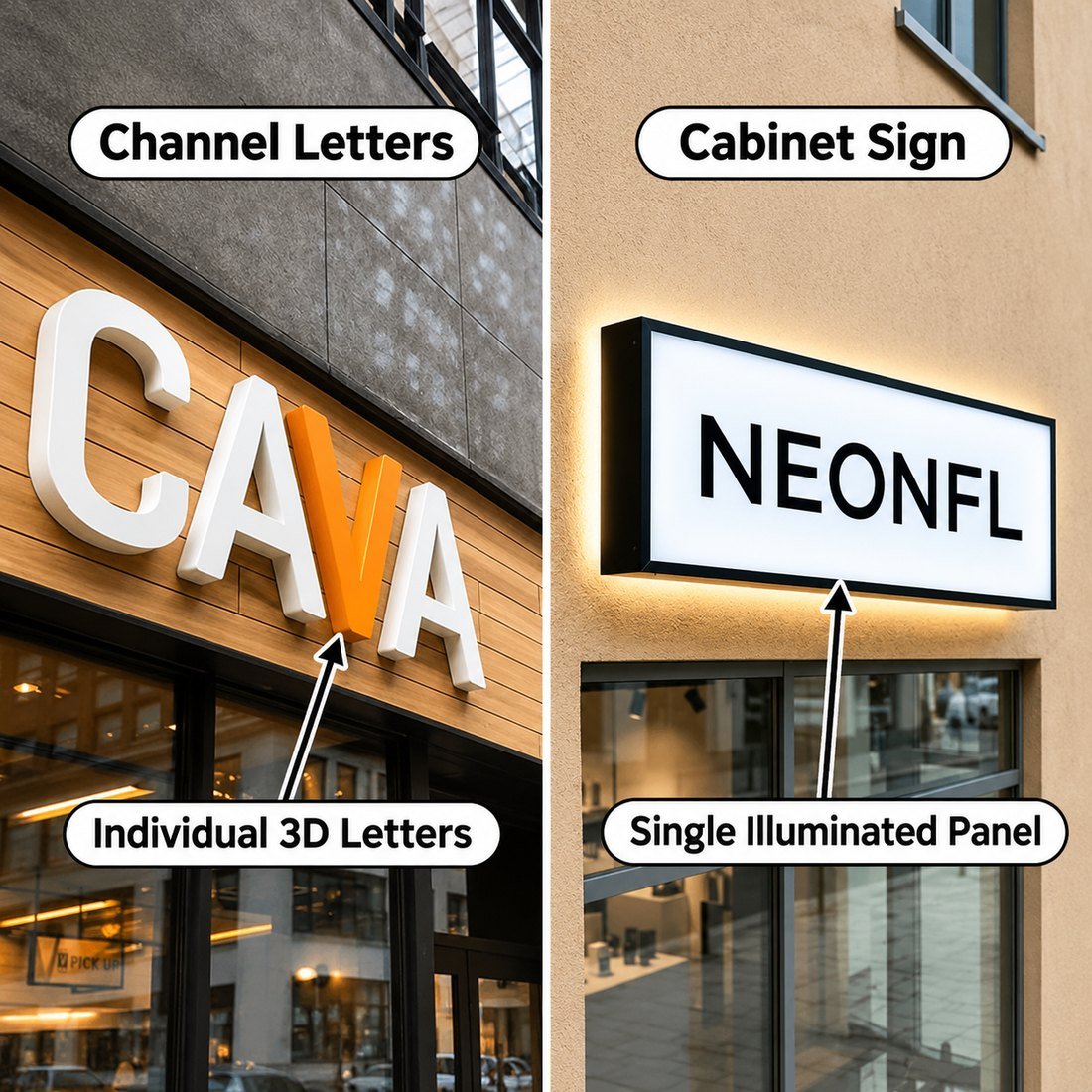
The same wall, two different answers
On the left, a channel letter set: individual letters, each with its own return, face and light source, mounted separately. On the right, a cabinet sign: one enclosed box with a single illuminated face carrying the whole message.
Both are lit, both mount to the same kind of wall, and they produce completely different impressions. That is the entire decision in one frame.
The table below compares the two on the factors that decide most projects.
| Factor | Channel Letters | Cabinet Signs |
|---|---|---|
| Appearance | Individual 3D letters with visible depth | Single panel, flat or slightly raised |
| Best for | Text-heavy branding, premium storefronts | Logo-heavy branding, detailed graphics |
| Illumination options | Front-lit, halo-lit, combination-lit, non-lit | Front-lit, edge-lit, backlit |
| Typical cost range | $3,000 to $12,000 | $1,500 to $6,500 |
| Installation complexity | Higher, individual letter mounting and wiring | Lower, single unit mounting |
| Maintenance | Replace individual letter components | Open cabinet to service LEDs and driver |
| Wind resistance | Lower profile per letter, less wind load | Larger flat surface catches more wind |
| Graphic flexibility | Limited to letter and shape outlines | Full-colour graphics, photos, gradients |
| Size flexibility | Scales well for very large text | Scales well for large graphic displays |
| Permit requirements | Varies by municipality | Varies by municipality |
Appearance and Brand Impact
This is where the decision usually starts. Channel letters project a premium, dimensional look because each letter has physical depth and casts its own shadow. That three-dimensional quality makes a storefront feel established and high-end, which is why you see channel letters on hotels, national retail chains, banks and upscale restaurants.
Cabinet signs present a flat, graphic-rich face that can display full-colour logos, photographs, gradients and complex artwork that channel letters simply cannot reproduce. If your brand identity depends on a detailed logo mark, a specific colour gradient or photographic imagery, a cabinet sign is the only illuminated option that renders all of that faithfully.
The visual difference comes down to dimension versus graphic range. Channel letters give you depth. Cabinet signs give you colour and detail.
Cost Differences
Channel letters typically cost more than cabinet signs for the same amount of wall coverage. Each letter is individually fabricated, lit and wired, and the labour scales with the number of characters.
A single-storefront channel letter set commonly runs $3,000 to $12,000 depending on letter count, size, material and lighting type. Halo-lit and combination-lit builds sit at the higher end. A cabinet sign of similar physical size typically falls in the $1,500 to $6,500 range, because the fabrication is a single unit rather than many individual pieces. Treat those as planning ranges rather than a quote.
For a deeper breakdown of what drives these numbers, the LED signage cost guide covers the ten factors that move a quote, and why there is no single fixed rate.
That said, cost alone shouldn’t drive the choice. A cabinet sign is less expensive, but if your brand needs a three-dimensional look, putting that saving toward a channel letter build that matches your identity is usually money better spent.
Illumination Options
Channel letters offer three standard lighting configurations.
Front-lit. LEDs face forward through a translucent acrylic face. This is the most common configuration and gives bold, readable text with strong contrast. Hicen’s front-lit channel letters are the standard option for most storefront builds.
Halo-lit, or backlit. LEDs face the wall, creating a glow around the back edge of each letter. The letter face is opaque, so the effect is a soft halo rather than a bright face. This look works well for upscale branding.
Combination-lit. LEDs face both forward and backward, giving you a lit face and a halo at the same time. This is the most expensive channel letter option but delivers the strongest visual impact, especially at night.
Cabinet signs are almost always front-lit, with the LEDs mounted inside the box behind the translucent face. Some designs use edge-lit configurations for thinner profiles.
Installation and Mounting
Channel letters require more installation work because each letter is a separate piece. The installer mounts each one individually to the wall, raceway or backer panel, runs wiring between letters, and connects the power supply. Alignment matters: letters that aren’t level or evenly spaced look wrong immediately.
Why channel letters take longer on site
Every letter is its own mounting point, its own seal and its own wiring connection. That is the labour premium you pay for the depth.
For many installations a raceway simplifies the electrical work. The raceway is a metal channel that mounts to the wall first, and the letters mount on top of it with all wiring contained inside. A full-size metal raceway also cuts down on wall penetrations and makes later service faster.
Cabinet signs are simpler to install because the entire sign is one piece. The installer mounts the cabinet, runs a single electrical connection, and the job is done. Fewer mounting points, fewer connections, and faster time on the wall.
For buyers importing from a factory like Hicen, both sign types ship with pre-wired LED assemblies and mounting templates. The manufacturing process includes a 48-hour power-on aging test before packing, so the electrical system is verified at the factory before it reaches your site.
Durability and Maintenance
Both sign types use LED modules rated for 50,000+ hours, and both are built to handle outdoor conditions when properly rated. IP65 is the rating you see most often on outdoor sign components.
The maintenance difference is practical. If a single LED module fails in a channel letter, the installer opens that one letter and replaces the module. The rest of the sign keeps running. If a module fails in a cabinet sign, the installer opens the entire cabinet, which is a bigger job if the cabinet is high on a wall or requires a lift.
Channel letter housings are individually sealed against moisture and dust. Cabinet signs rely on a single seal around the access panel or face frame. In coastal or high-humidity environments, the individual sealing of channel letters can be an advantage.
Material choice matters for both types. For a comparison of aluminium, stainless steel, acrylic and other sign materials, the signage materials guide covers durability, corrosion resistance and application fit for each. The LED signage lifespan guide covers what actually shortens a sign’s service life.
Which One Fits Your Business?
The choice depends on your brand identity, your budget, and how your sign will be seen.
Choose channel letters if:
- Your brand is text-driven and you want each letter to stand out individually.
- You’re aiming for a premium, established look on a storefront or building facade.
- Your sign will be viewed from straight ahead at relatively close range.
- You have the budget for a higher-cost, higher-impact sign.
Choose a cabinet sign if:
- Your brand depends on a detailed logo, full-colour graphics or photographic imagery.
- You need to cover a large area with bright, even illumination at a lower cost per square foot.
- You want faster, simpler installation with fewer mounting points.
- You’re on a tighter budget but still need an illuminated, professional sign.
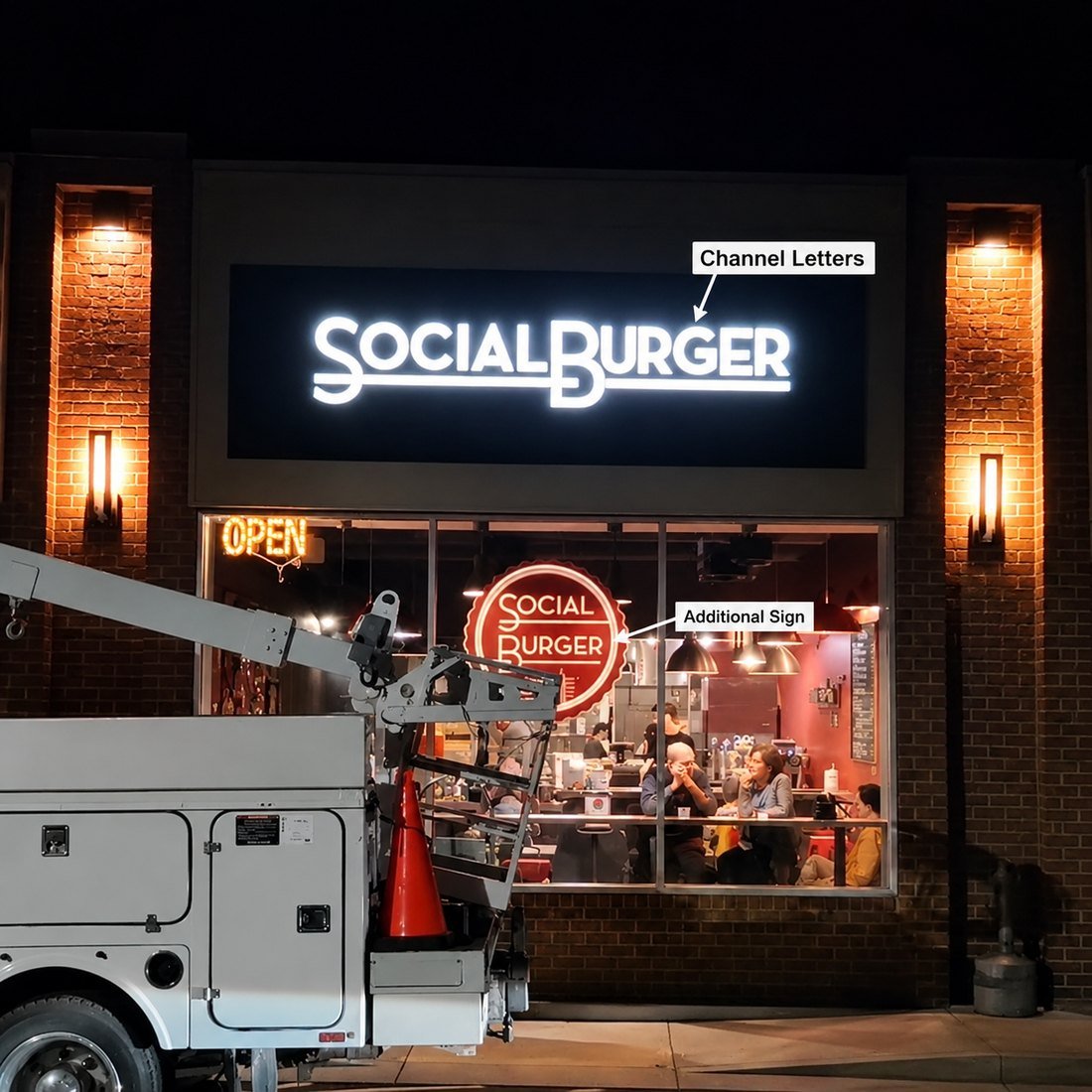
Some businesses use both. A channel letter set for the business name with a cabinet sign for the logo panel below it is a common combination. Fast food restaurants, gas stations and retail plazas use this approach regularly to get the dimensional text and the graphic logo in one installation.
How to Decide and Get Started
Start with your brand files, your storefront dimensions, and the viewing distance, meaning how far away the sign needs to be readable. Those three inputs determine whether channel letters, a cabinet sign, or a combination of both makes sense.
If you’re not sure which direction fits, the signage selection guide walks through the decision process and helps you narrow down the right type before you request a quote.
When you’re ready, send your logo and storefront dimensions to Hicen’s team. You’ll receive a free design rendering within 1 to 2 hours and a quote within 24 hours, and there’s no minimum order for either sign type.
Frequently Asked Questions
Are channel letters more expensive than cabinet signs?
Yes, generally. Channel letters cost more because each letter is individually fabricated, lit and wired. A channel letter set for a single storefront commonly runs $3,000 to $12,000, while a cabinet sign of comparable size typically falls in the $1,500 to $6,500 range. The gap narrows on smaller signs and widens on larger builds, and both figures are planning ranges rather than a quote.
Can a cabinet sign look as premium as channel letters?
A well-designed cabinet sign with high-quality face material and clean finishing can look very professional. But it won’t replicate the three-dimensional depth and shadow effect that gives channel letters their premium appearance. The two sign types serve different visual purposes.
Which sign type is better for a restaurant?
It depends on the restaurant’s brand. A fine-dining restaurant that wants an upscale, understated look usually benefits from halo-lit or combination-lit channel letters. A fast-casual chain with a graphic-heavy logo often gets more value from a cabinet sign that renders the full logo in colour. Many restaurants combine both.
Do both sign types use LED lighting?
Yes. Both channel letters and cabinet signs use LED modules as the standard light source. LED has replaced neon and fluorescent in virtually all new commercial signage because of its lower power consumption, longer lifespan and better brightness consistency.
How long do these signs last?
Hicen’s own lifespan guide puts a well-built LED sign at 8 to 12 years or longer, and LED modules themselves are typically rated for 50,000+ hours. The main factors that shorten sign life are poor material choices for the environment, corrosion in coastal areas and UV degradation in high-sun regions, plus incorrect electrical installation.
Get a Quote
Send Your Logo and Storefront Dimensions
Hicen returns a free design rendering within 1 to 2 hours and a quote within 24 hours. No minimum order for either sign type, and a single piece is accepted.