Signage greets a guest before your front desk does. Here are the sign families a hotel actually needs, from the rooftop letters down to the room number, plus the ADA dimensions that belong in the drawings before anyone quotes the job.
Why Hotel Signage Matters
A hotel is a journey through space. Signage is what makes that journey smooth, or rough. Guests arrive with luggage and no mental map of the building, and every sign they cannot find becomes a question at the desk.
Clear wayfinding cuts those questions, which means less time spent giving directions and more time for the work guests notice. The same signs do quiet brand work: a consistent system signals a property that is run properly, while mismatched plaques and peeling vinyl say the opposite.
Accessibility signage is not a finishing touch either. In many markets it is required by law, and it is checked against fixed dimensions rather than judged on looks. That is why the ADA section below is written as a specification.
For the full catalogue of formats, the 40+ business sign types guide covers every sign type by location and function.
Exterior Signs
Exterior signs pull guests in and mark the entrance. They work day and night, in weather, and they are usually the largest line in a hotel sign budget.
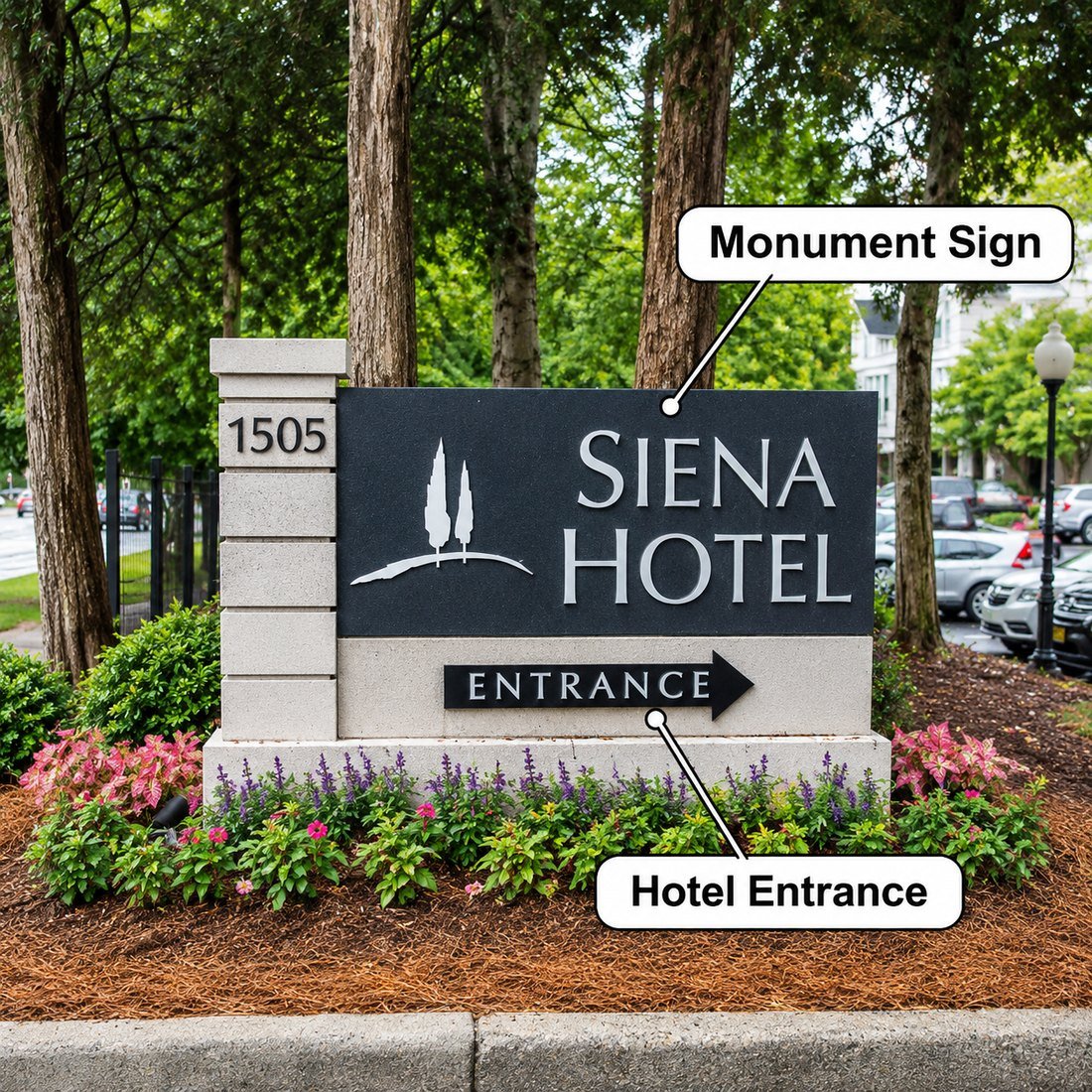
Building Identification Sign
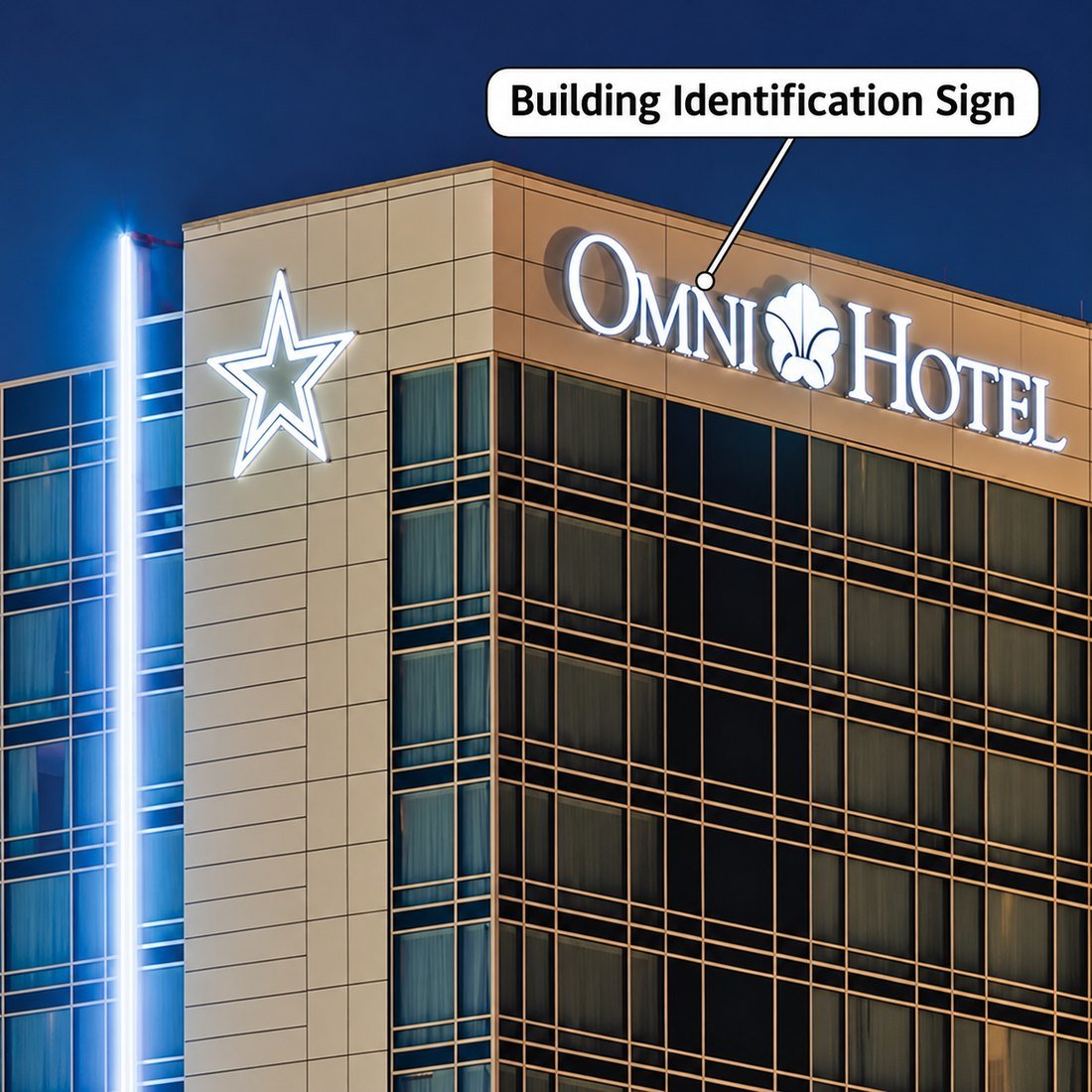
This is the primary sign. It carries the hotel name and brand mark on the building face. Large hotels use illuminated channel letters on the facade, and some add a rooftop sign for highway visibility, which brings wind load and a structural review with it.
The custom building signs line covers letter sets and cabinet builds for exterior walls, including the raceway detail that keeps a facade sign weathertight.
Monument and Entrance Signs
A monument sign marks the driveway and entrance. It sits low, close to the road, and does what a facade sign cannot: it tells a driver they have arrived and where to turn. Read at speed and at an angle, letter height and contrast matter more than detail, and illumination keeps it working after dark when a large share of check-ins happen.
Directional Entry Signs
Guests need to find parking, the lobby and check-in, in that order, often with a queue behind them. Clear entry directionals prevent the loop around the block that starts a stay badly.
Exterior directionals take the worst of the weather, so specify them for permanent outdoor use. The custom illuminated signs range covers lit exterior options.
Lobby and Reception Signs
The lobby is your brand’s stage. It is the one space every guest stands in, often twice, and the signs there end up in arrival photos and reviews.
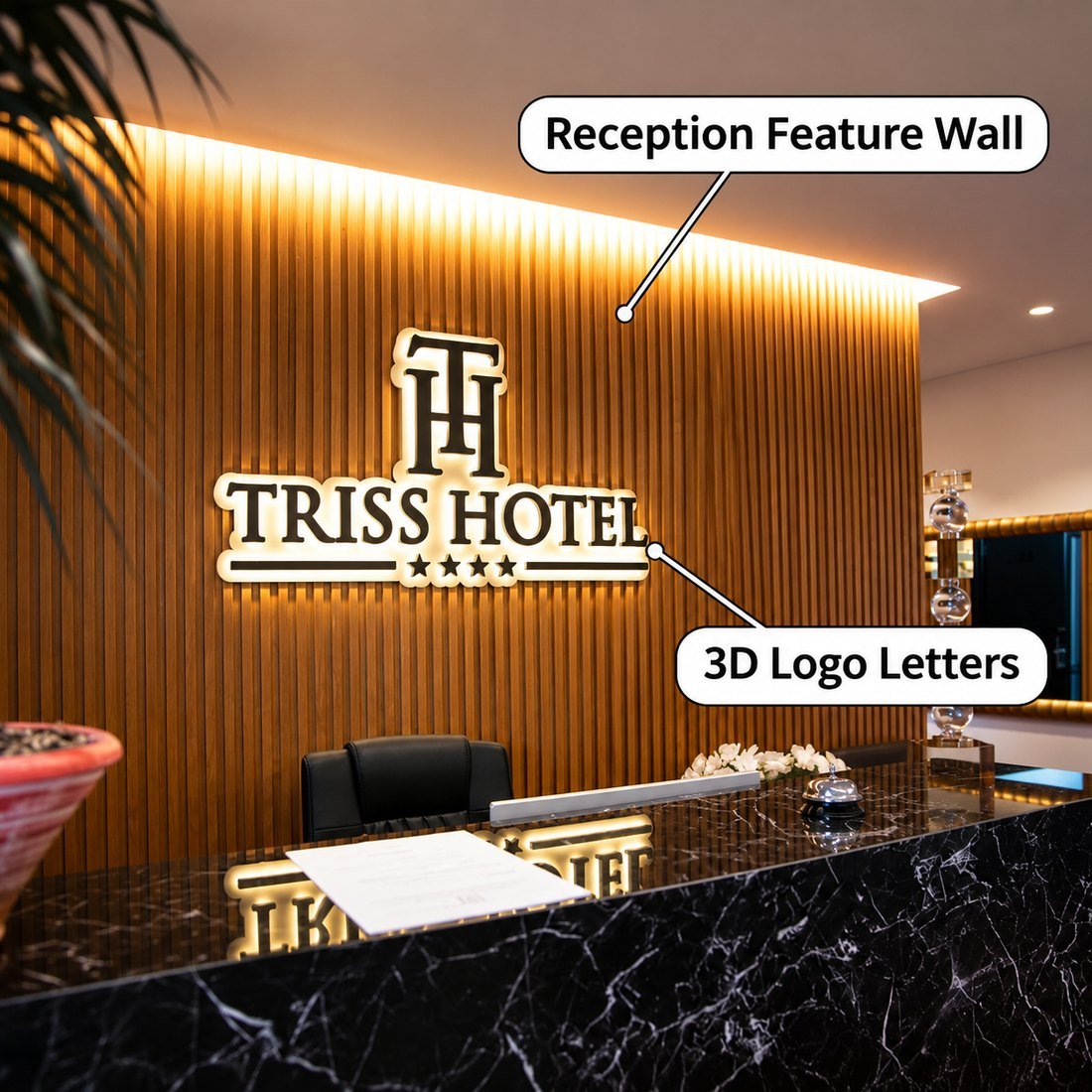
Dimensional letters behind the front desk anchor the space. They put the brand at the centre of every arrival photo and read as permanent in a way a printed panel never does.
Brushed metal reads modern and upscale; halo-lit letters on timber or stone read warmer. Both are finish decisions that depend on the lighting already in the ceiling.
Reception Feature Wall
A feature wall is a lighting design as much as a sign. Letters mounted 20 to 30 mm off the wall throw a halo a flush set cannot, and the wall surface becomes part of the effect. Decide the wall finish before the letter depth, not after.
The 3D sign letters line covers metal, acrylic and illuminated builds, including the standoff and transformer detail that has to be planned into the wall.
Brand and Welcome Signs
A welcome sign sets the mood on entry. It can carry a tagline, an event greeting or one line of text, and it is the cheapest sign in the building to change when the brand refreshes.
Match the material to your brand, budget and environment. Metal reads premium, wood reads warm, and acrylic suits clean contemporary interiors and takes colour well. None of those is a rule, and a resort and a city business hotel should not land on the same answer.
Wayfinding and Directional Signs
Wayfinding is the backbone of hotel signage. It moves guests through the building without a staff escort, and it is judged by how rarely anyone has to ask.
Guests need to find the elevators, the restaurant, the meeting rooms and the amenities. A directional sign at each decision point makes that simple, and the points are predictable: lift lobby, corridor junction, the end of a long hallway.
Good wayfinding uses consistent icons and clear arrows, in the same place on every floor. Guests barely notice it when it works, which is the point.
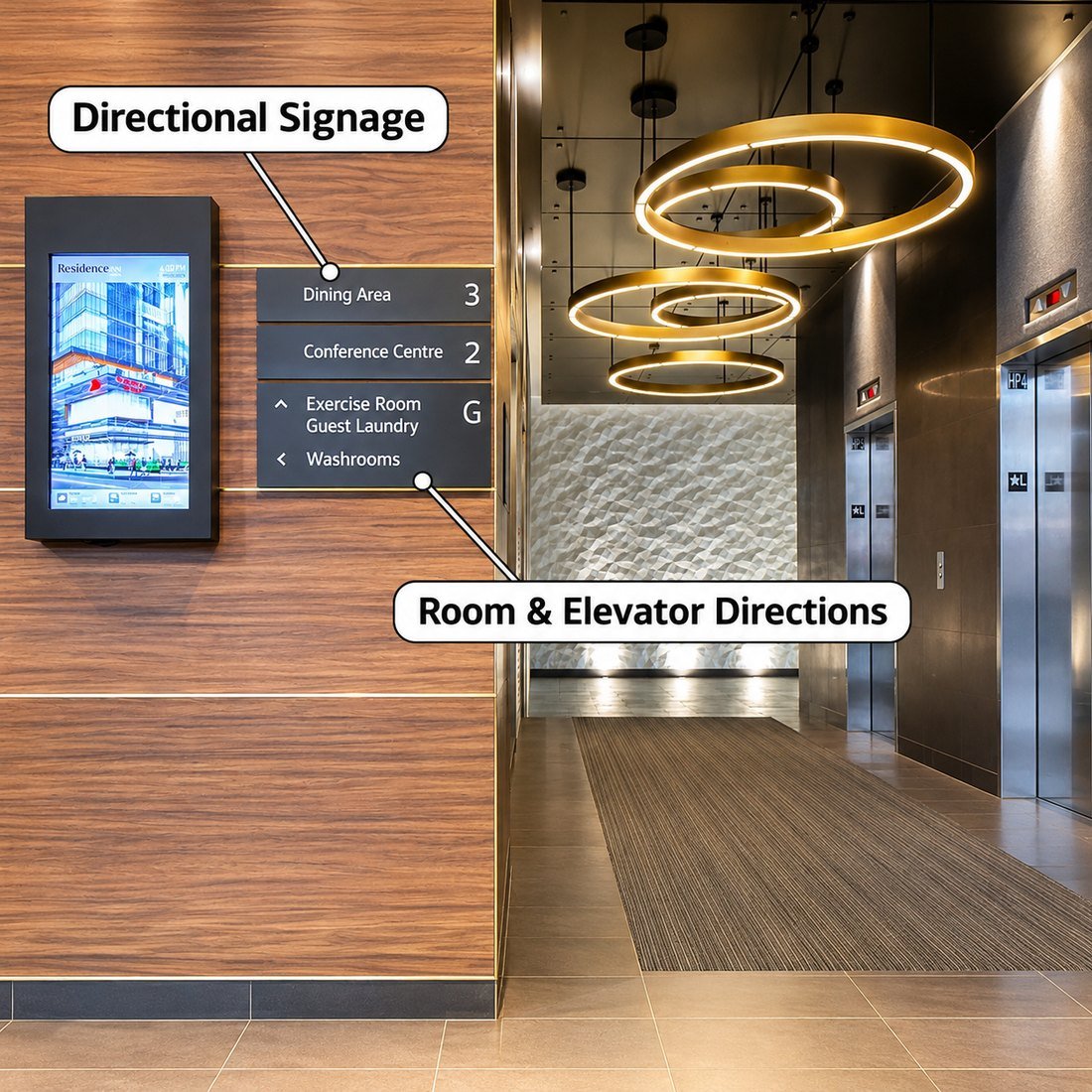
Consistency is what makes a system rather than a collection of plaques: same typeface, same arrow style, same mounting height, same colour for the same destination on every floor. Change one of those and guests stop trusting the rest.
The custom wayfinding signs line covers directories, directionals and room identification, and the wayfinding sign formats page is worth reading before you fix a grid.
Room and Floor Identification
Every guest reads these signs daily, usually tired, and they are the signs most likely to be non-compliant in an older property.
Room ID signs sit beside each door. They need clean type and a tactile, accessible build, because these are the signs the accessibility rules actually bite on.
Consistent room signs look organised and professional. Mismatched ones make guests doubt the rest of the floor.
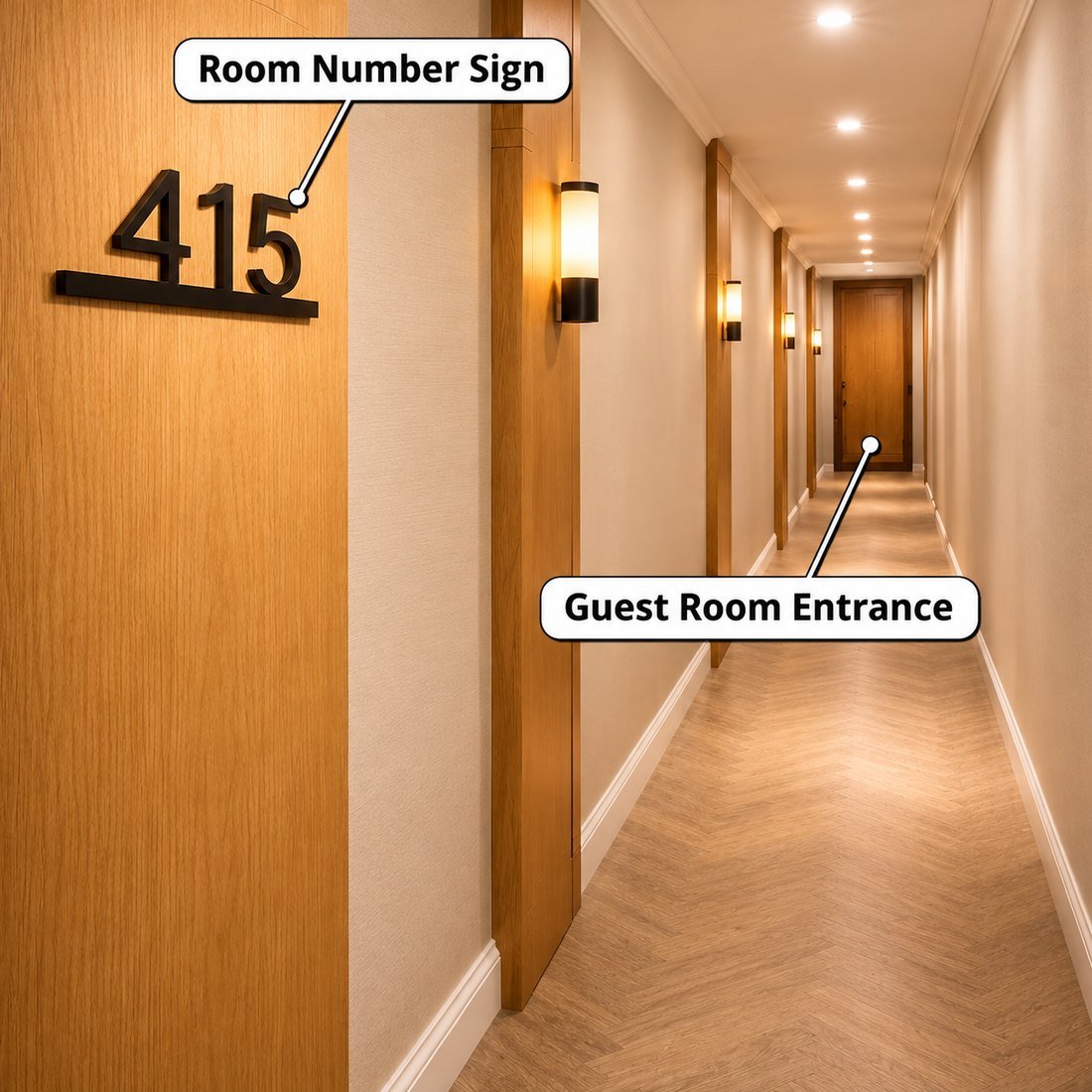
Room Number Signs
Decorative numbers are often mounted on the door face, as in the photo above. Where a sign has to meet ADA it moves to the wall on the latch side of the door, at the height in the next section. Decide which of the two you are buying before the doors are drilled.
Floor and Elevator Signs
Guests orient themselves at the elevator, so clear floor numbers matter, and the elevator lobby is also where a directory earns its keep. Elevator jamb signs mark each floor by number, and in the US the tactile requirements on hoistway floor signs differ slightly from room signs, so check them separately.
ADA and Accessibility Compliance
Accessibility signage is a legal requirement in many markets, and it is also the right thing to do. It is the one part of a hotel sign package checked against numbers rather than taste.
In the US, the 2010 ADA Standards set the rules for permanent room and space signs. The U.S. Access Board’s Chapter 7 guide is the readable version of the text, and it is the one worth sending to your fabricator.
Requirements depend on the sign’s function and location. Tactile and braille rules apply to permanent rooms and spaces, not to every sign in the building. Treat the table below as a printable checklist, and work through it in order, because the clear floor space and mounting height decisions constrain everything else.
| Sign element | ADA requirement |
|---|---|
| Clear floor space | 18 x 18 in minimum, centred on the tactile characters |
| Mounting height | 48 in minimum to the lowest baseline, 60 in maximum to the highest |
| Character depth | 1/32 in minimum raised above the surface |
| Character height | 5/8 in to 2 in (1/2 in minimum where visual text is on a separate sign) |
| Stroke width | 15% maximum of the uppercase I height |
| Braille | Grade 2, below the text, 3/8 in minimum separation |
| Finish and contrast | Non-glare, light-on-dark or dark-on-light |
Clear Floor Space
Leave an 18-inch by 18-inch clear space, centred on the tactile characters, on the latch side of the door. It has to sit outside the door swing, beyond the 45-degree open position, with nothing protruding into it below 80 inches from the floor.
Mounting Location and Height
Mount tactile signs on the latch side of the door. Height is measured to the character baselines, not the edge of the plaque: the lowest tactile line sits at least 48 inches above the floor, the highest no higher than 60.
Characters
Tactile characters are raised at least 1/32 of an inch, in all-uppercase sans-serif type, 5/8 inch to 2 inches high where they also serve as visual text. Stroke width stays within 15 percent of the uppercase I height, spacing runs from 1/8 inch to four times the stroke width, and the uppercase O must be 55 to 110 percent of the I height.
Braille
Grade 2 braille sits below the raised characters, separated by at least 3/8 inch from the tactile text and from any raised border. It repeats the printed text rather than adding to it.
Finish and Contrast
The finish must be non-glare, and characters light-on-dark or dark-on-light. The standard sets no numeric contrast ratio, which is why two compliant signs can look very different, and why the higher-contrast one reads better in a dim corridor.
The custom acrylic sign line covers tactile and braille plaques, including the laser-cut and subsurface-printed builds that hold character depth reliably.
Amenity Signs
Amenity signs point guests to the features they paid for, and they promote on-site spending at the same time. Common sets cover the pool, fitness centre and spa, then the restaurant, bar and business centre.
Clear amenity signage can increase usage. Guests often spend more when they can find the facilities, and a sign that names the opening hours removes a question the desk would otherwise answer ten times a day. Match these to your interior branding, because they are small enough that a mismatched set is obvious the moment a guest turns a corner.
Safety and Egress Signs
Safety signs protect guests and keep you compliant. They are not optional, and they are the one family where the local authority has the final word.
Exit signs mark egress routes clearly. The International Fire Code’s evacuation-plan provisions for Group R-1 occupancies are why hotels post an evacuation diagram inside each guest room, and why that diagram has to match the corridor it describes. Confirm which edition your jurisdiction has adopted before you print a run.
Fire and emergency signs follow local building code, and your fire-code professional and the local authority decide the specifics. Keep them legible in low light and in smoke: photoluminescent and illuminated options are both common, and the choice usually follows the egress path rather than the budget.
Parking and Valet Signs
Parking signs guide guests from the road to a space, and they prevent the frustration of a lost arrival, which is the most common way a good stay starts badly. Valet signs mark the drop-off and pickup zones, and guests notice them because they are looking at the exact moment they are anxious about the car.
Digital and Event Signage
Many hotels add digital signs for flexibility. Content changes in seconds and updates without a reprint, which matters in a property hosting something different every week.
Digital boards show event schedules and meeting room assignments, so they suit conference hotels where a printed directory is out of date before it is installed. A lobby display can also promote on-site dining and offers, and it earns its cost through added bookings rather than by replacing the static wayfinding a guest reads at a glance.
What a Hotel Sign Package Costs
A hotel needs many signs at once: dozens, sometimes hundreds, ordered together and installed to one schedule. That is why buyers in this sector budget as cost per key rather than per sign, dividing total signage spend by room count so large projects stay comparable through scope changes.
A 100-room property typically has 300 to 600 sign locations. That covers room IDs, door plates and evacuation maps, plus amenity, wayfinding and exterior signs. Interior signs cost less per piece than exterior ones, and exterior illuminated signs are usually the largest line item.
| Area | Typical signs | What drives the count |
|---|---|---|
| Exterior and building ID | Channel letters, monument, entry directionals | Facade size, road visibility, number of approaches |
| Lobby and reception | Feature wall letters, welcome sign, desk signage | One set per entrance, plus back-of-house |
| Wayfinding | Directories, directionals, floor plates | Decision points on each floor |
| Guest floors | Room numbers, door plates, evacuation maps | Room count and corridor layout |
| Amenities | Pool, fitness, spa, restaurant, business centre | Number of facilities and their access routes |
| Safety and egress | Exit signs, fire equipment identification | Local code and the fire consultant’s review |
| Parking and valet | Entry, level and drop-off signs | Lot or garage layout and traffic flow |
These are illustrative planning figures, not a quote. For the per-sign ranges behind them, the custom business sign cost guide breaks the numbers down by sign type.
Materials and Brand Consistency
Every hotel sign should look like one family. Consistency is most visible where two sign types meet: the lobby letters against the corridor plaques, and it is there that a mixed package gives itself away.
Use the same fonts and logo across every sign, and carry the palette from the rooftop to the room number. The custom metal signs line covers brushed and painted finishes, and the signage material selection guide helps match a material to each location.
Franchise Brand Standards
Franchised hotels do not have a free hand. Brands such as Marriott and Hilton set the rules through a prototype manual and, for renovations, a property improvement plan that controls sign sizes, colours and fonts. Some brands name approved vendors, and renovations must pass a brand standard review. Only independent hotels have full design freedom, so confirm your brand package before you finalise any sign.
Why Choose Hicen for Hotel Signage
A hotel needs many sign types at once. Sourcing them from one factory keeps the brand consistent, because the same team matches finishes across a channel letter set, a reception wall and a corridor plaque.
Hicen builds the full package under one roof: exterior signs, lobby letters, wayfinding and ADA plaques. One supplier means one brand standard and one point of contact, and it simplifies shipping and project management when several sign types have to land on site in the right order.
Standard production runs 7 to 15 working days after drawing approval, with samples typically ready in 3 to 5 working days. The manufacturing process page walks through each stage, and quality control covers the checks before packing.
Local code review, permits and installation still happen on site. Plan those with your local team, and treat the factory scope as fabrication, finishing and export packing.
Plan Your Hotel Sign Package
Hotel projects order from a sign schedule. It turns a design intent into a priced package, and a complete one shortens the quote cycle more than anything else you can send.
- Room count and floor plans, so room numbers, door plates and evacuation maps can be counted
- The brand standard or prototype manual, if the property is franchised
- Sign locations marked on the drawings, including latch-side walls for tactile signs
- Finish and material direction, or a reference photo of an existing property
- Which signs must be illuminated, and the electrical supply available at each location
- Installation scope: supply only, or supply with site support
Send your sign schedule to the Hicen team and expect a quote within 24 hours, with a free design draft in 1 to 2 hours.
Frequently Asked Questions
What signs does a hotel need?
A hotel needs several sign families. Start with exterior building signs and lobby signs, then add wayfinding, room identification and ADA accessibility signs. Include amenity, safety and parking signs, and larger properties often add digital signage.
What is wayfinding signage in a hotel?
Wayfinding signage guides guests through the property. It covers directories, directional arrows and room identification, and good wayfinding helps guests find the elevators, restaurants and amenities without asking staff.
Are hotels required to have ADA signs?
In the US, yes. The ADA requires accessible signs for permanent rooms and spaces, with raised tactile characters, Grade 2 braille and a non-glare finish. Characters must be light-on-dark or dark-on-light.
How high should ADA hotel signs be mounted?
For tactile room signs, the lowest character baseline sits at least 48 inches above the floor and the highest no more than 60 inches. The sign goes on the latch side of the door, with 18 by 18 inches of clear floor space centred on the characters.
What material is best for hotel lobby signs?
It depends on your brand. Brushed metal reads modern and upscale, acrylic suits clean contemporary interiors, and warm wood tones suit boutique and resort properties. Match the material to the interior design and the lighting already in the space.
How do hotels keep signage consistent across the property?
Use the same fonts, colours and logo on every sign, and source the whole package from one manufacturer so materials and finishes match. Carry the brand from the exterior building sign down to the room numbers.
What safety signs does a hotel need?
Exit signs mark egress routes, and the fire code’s evacuation-plan provisions for Group R-1 occupancies are why hotels post an evacuation diagram in each guest room. Fire and emergency signs follow local building code, and your fire-code professional sets the specifics.
Do franchise hotels have design freedom with signage?
Not fully. A brand’s prototype manual or property improvement plan sets sign sizes, colours and fonts, and some brands name approved vendors. Only independent hotels have full freedom.
How long does hotel signage take to produce?
Standard production at Hicen runs 7 to 15 working days after drawing approval, with samples typically ready in 3 to 5 working days. A full hotel package with many sign types takes longer, so plan early for new builds and renovations.
How much does hotel signage cost?
Hotels budget signage as cost per key. A 100-room property typically has 300 to 600 sign locations, and exterior illuminated signs are the largest line item. Request a package quote from your full sign schedule rather than a per-sign estimate.
Get Your Hotel Sign Package Quoted
Send Your Sign Schedule for a Package Quote
Share your room count, floor plans and brand standard. You get a full package quote and a free design draft, with one point of contact across every sign type.