A rooftop sign is the only sign type where the engineering decides whether the project exists. Here is how the format, the wind load, the roof attachment and the crane each move the number.
What Is a Rooftop Sign?
A rooftop sign is a large sign mounted on top of a building, standing above the roofline on a steel support structure rather than lying flat against the facade. It is read from the approach directions it faces, which is why it works where street-level signage cannot.
That height is the whole point, and it is also the problem. A rooftop sign clears trees, traffic and competing shopfronts, so it is seen from a kilometre away. It also catches wind at the height where wind is strongest, carries real weight, and has to be tied into a building that was not designed with a sign in mind.
You see them on hotels, shopping centres, car dealerships and office towers. They earn their place wherever a business needs long-range visibility above street clutter — and they are the one sign type where the engineering, not the artwork, decides whether the project happens.
| Sign type | How it mounts | Structure needed | Approval burden |
|---|---|---|---|
| Rooftop | On the roof, above the roofline | Steel frame tied into the building, or a ballasted frame | Highest — zoning, landlord criteria and stamped drawings |
| Wall | Flat against the facade | Wall fixings, sometimes a raceway | Moderate — a permit is usually required |
| Monument | Ground level on its own base | Foundation and base | Moderate — setbacks and height caps |
| Pylon | Mast above grade | Foundation, often engineered | Moderate to high once the structure gets tall |
For the full catalogue by location and function, the 40+ business sign types guide covers every format, and the commercial building illuminated signage guide covers the illuminated side of the same decision.
Types of Rooftop Signs
Four formats account for almost every rooftop sign. Which one you choose depends on the brand, the budget, and what the building structure underneath can carry.
Illuminated Channel Letters
Individual 3D letters on a steel frame, each with its own LED modules inside the return. This is the premium option for a brand name, and the one that reads best at night from a distance.
On a tall building the letters are usually mounted to a structural frame that is itself tied into the roof slab or columns. Every letter is a separate fabricated, wired and mounted unit, which is why rooftop channel letters sit at the top of the price table.
Halo-lit letters, where the glow comes off the wall behind them, are harder to do on a rooftop: there is often no wall behind the letters, so the frame has to carry a backing panel to bounce light off.
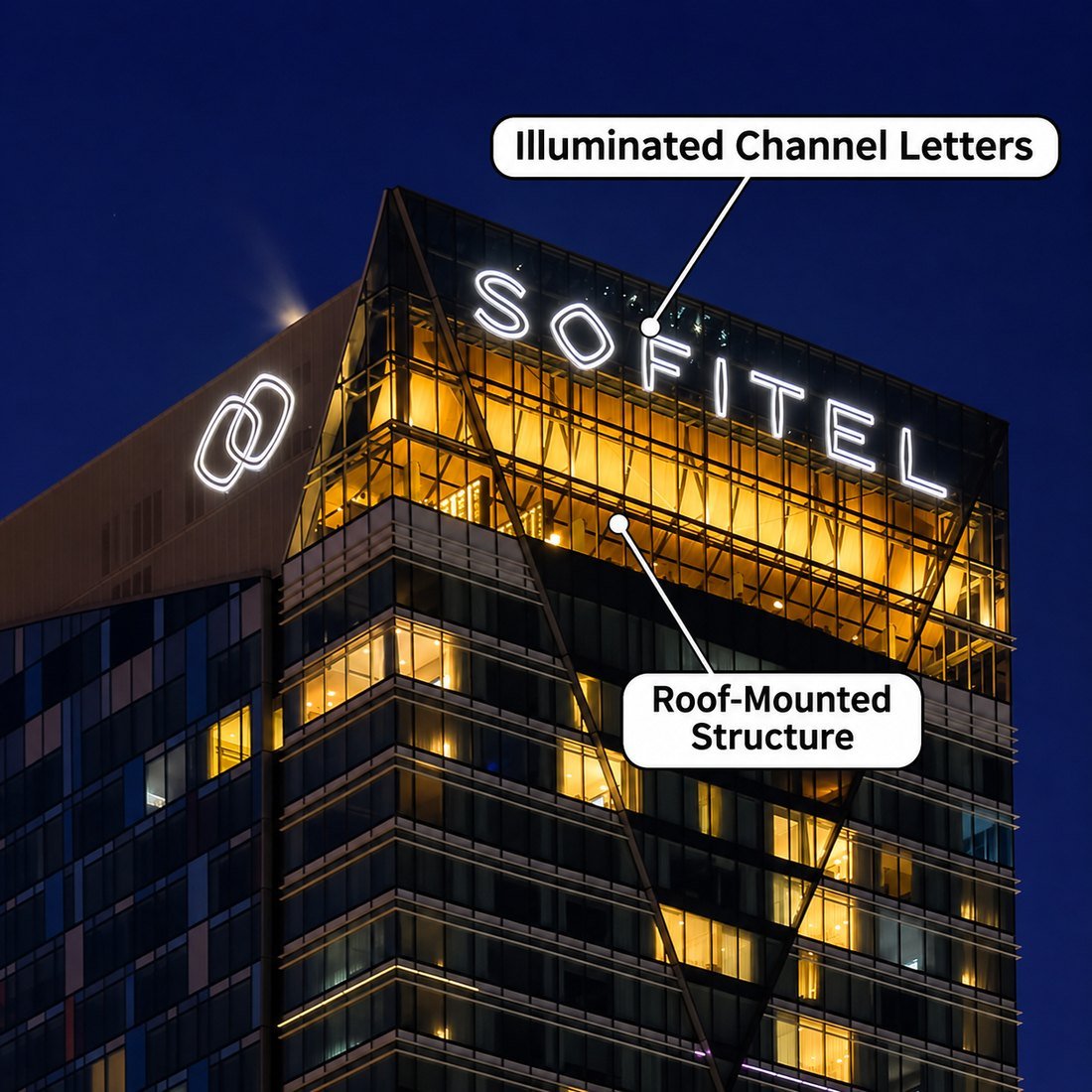
The channel letter range covers build options, materials and lighting types.
Cabinet Signs
A cabinet sign is one enclosed box with an illuminated face, carrying the full logo and graphics in colour rather than just the name. It covers a large area of roof edge for less than the equivalent set of letters.
Cabinets are common on hotels and shopping centres because a single face can carry a mark, a sub-brand and a descriptor at once. The trade-off is depth and weight: a cabinet is a box, and a rooftop frame has to hold that box in wind.
Frameless and standard builds both exist; the frame type decides how the face is tensioned and how the cabinet sheds water.
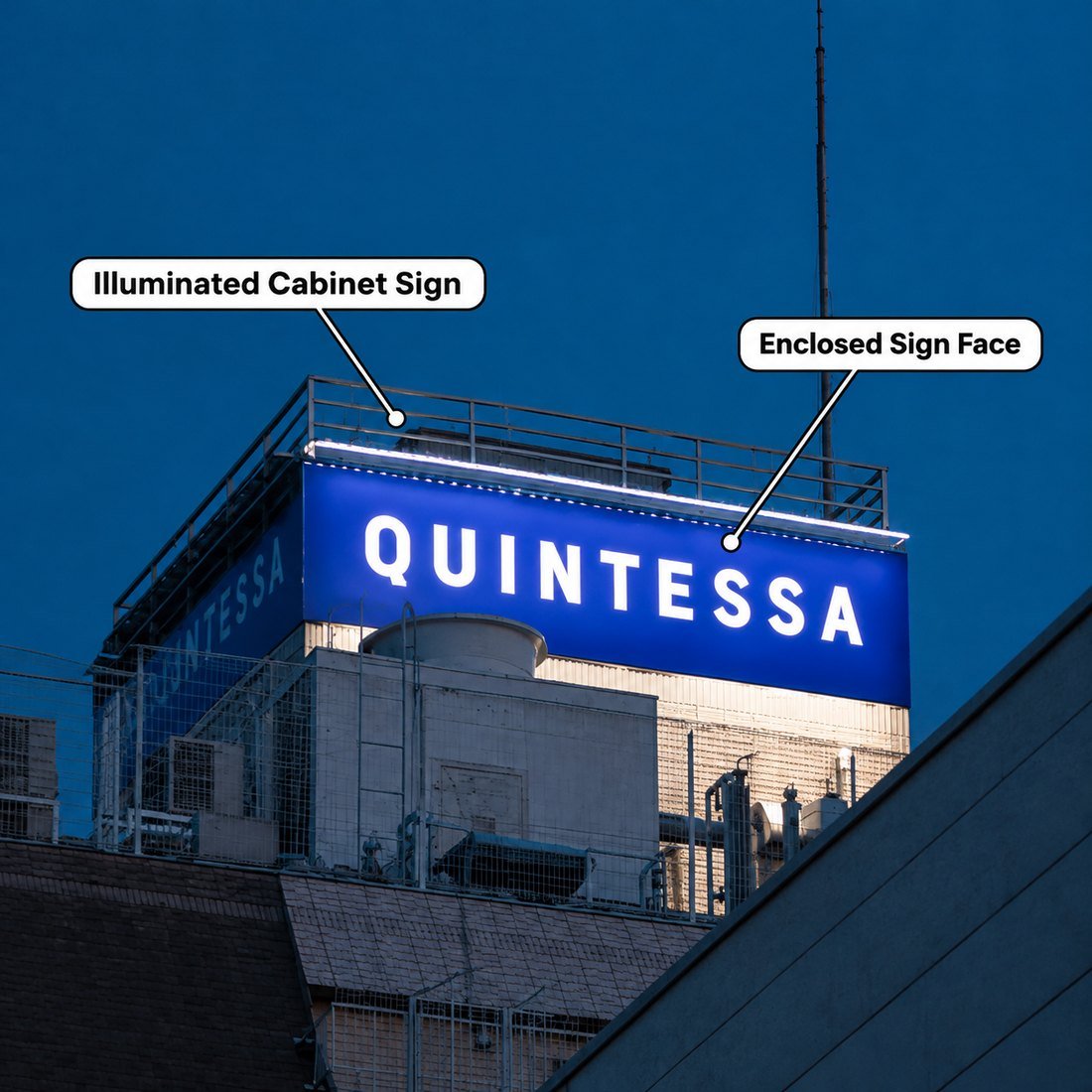
The LED light box line covers frameless and standard builds.
Billboard-Style Structures
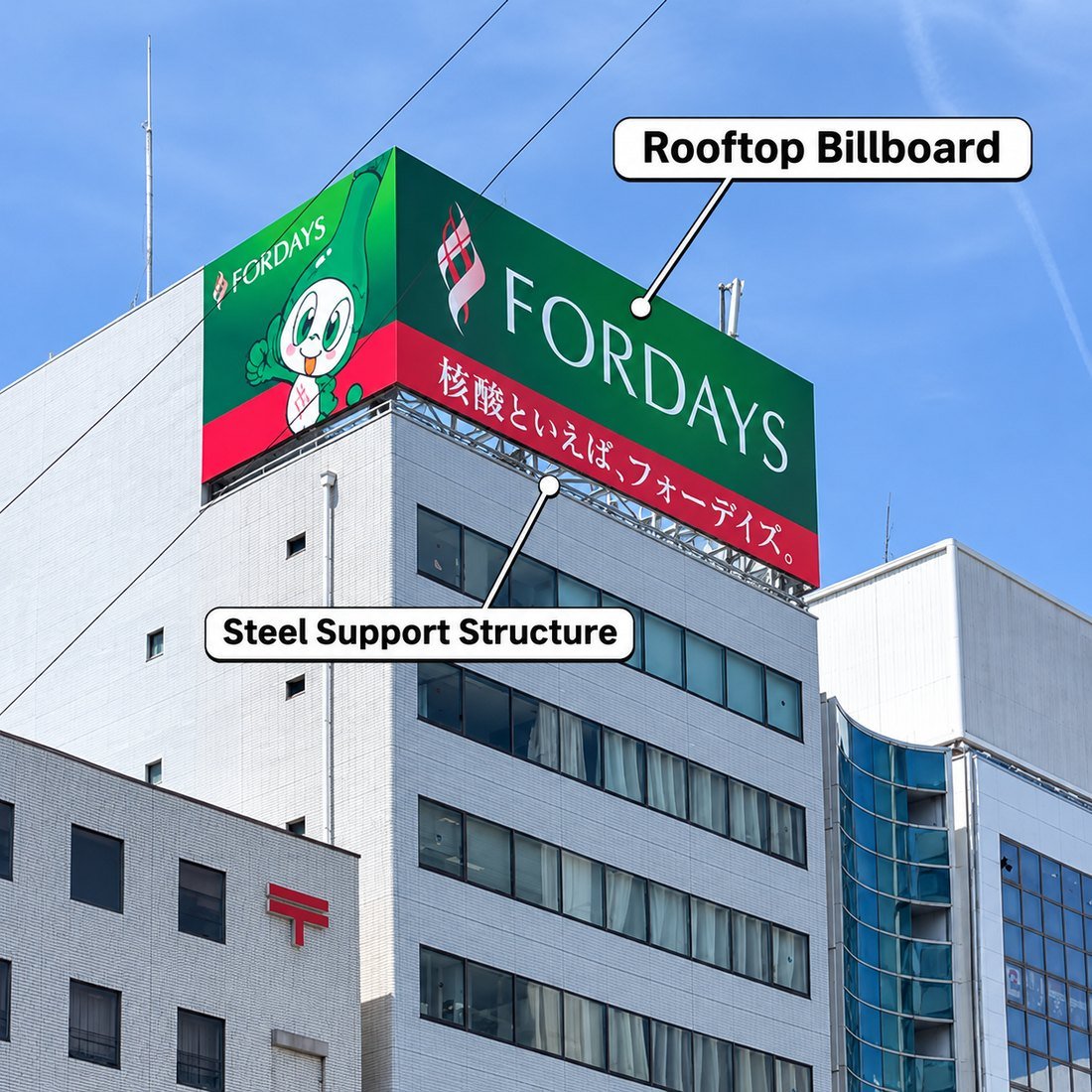
A large branded face on a roof-mounted steel structure. These read like a billboard from the highway, and they suit businesses whose value proposition fits in a few words — a mall, a car dealership, a distribution centre.
A billboard face is mostly structure: the printed panel is cheap relative to the steel and the connections that hold it. That is why the cost conversation for this format is an engineering conversation first.
Because the face is large and flat, wind load is the dominant design case. A billboard on a rooftop is effectively a sail mounted on a lever, and the frame has to resist overturning as well as the panel itself.
Dimensional Letters
Non-illuminated or halo-lit letters for a clean daytime look. They suit daytime-focused businesses in bright locations, or buildings where the roof edge is visible from close range and a lit sign would be overkill.
They are the cheapest of the four to fabricate and the lightest to mount, but they do nothing after dark. On a site where most of the traffic passes at night, that is a false economy.
Hicen builds all four formats. The custom building signs line covers letter sets and cabinet builds for roofs.
Design Principles for Rooftop Signs
A rooftop sign is seen from far away, and every design decision follows from that distance. Size, contrast and lighting are not taste questions here — they are legibility calculations.
Letter Height and Viewing Distance
The working rule is roughly one inch of letter height for every ten feet of viewing distance, under good daylight contrast with a reader who is not moving. A rooftop sign is read by people moving fast, so treat the result as a floor, not a target.
| Viewing distance | Minimum letter height | Typical rooftop case |
|---|---|---|
| 300 ft | 2.5 ft | Neighbourhood strip centre, sign read from the street |
| 500 ft | 4.2 ft | Arterial road, mid-rise building |
| 700 ft | 5.8 ft | Arterial road with a setback |
| 1,000 ft | 8.3 ft | Highway approach |
| 1,500 ft | 12.5 ft | Highway, at the practical limit for letters alone |
Past roughly 1,500 feet, letter height stops being the answer. At that distance atmospheric haze and the angle of the approach matter more than another foot of letter, so the design shifts to a shorter mark, a bolder silhouette and stronger contrast.
The letter height and viewing distance rules carry the corrections for speed, night viewing and weak contrast.
Contrast and Colour
High contrast wins at distance, and simple beats busy. Light letters on a dark face, or the reverse, read best. Low-contrast pairs — red on black, dark blue on black — disappear in daylight at range even when they look sharp on a screen.
A rooftop sign is also seen against the sky for most of the day, which is a moving background. A dark face silhouettes well against a bright sky; a pale face disappears into an overcast one. Check the colour choice against the sky the site actually has, not against a white artboard.
Illumination
Most rooftop signs are lit, because the hours that matter most for a sign at height are dusk and dark. LED is the standard source: front-lit letters for a bright readable face, halo-lit for a softer, more upscale glow.
Module datasheets commonly rate LEDs at 50,000 hours to L70, which is a brightness rating rather than a service-life promise — the driver, the face material and the seal usually need attention before the LEDs themselves fail. A well-built sign in normal service is estimated at 8 to 12 years.
The LED signage lifespan guide explains what wears out first and how to compare suppliers on it.
Safety and Structural Engineering
This is where a rooftop sign stops being a sign and becomes a structure. It sits high, catches wind, carries real weight, and is usually above people and property. Getting the engineering wrong risks the sign, the roof and public safety.
Every rooftop project therefore starts with the building, not the artwork: what the roof is made of, where the load can go, and what the governing code requires. A licensed structural engineer works from the building drawings and a site survey.
Wind Load
Wind is the governing force on almost every rooftop sign. Engineers size the structure to a wind-load standard — ASCE 7, whose current edition is ASCE 7-22 — using the local design wind speed, the height above grade, the exposure category and the face area. A licensed engineer verifies the numbers for your specific site.
Coastal and storm zones demand far stronger builds. Hicen engineers to each site’s code design wind speed, which in high-wind zones is typically in the 140 to 180 mph band — but the stamped number for your address is what governs, not a marketing label.
That distinction matters. Category 5 is a Saffir-Simpson storm classification beginning at 157 mph sustained, not a structural design wind speed. A proposal that says “hurricane-rated” or “Category 5” without naming the design wind speed and the code edition it was calculated against does not give you a design basis.
The hurricane-resistant sign engineering guide works through the design basis, exposure category and the load path from panel to foundation.
Roof Attachment: Anchored or Ballasted
A rooftop sign needs a steel frame tied into the building structure. The project engineer determines the load path and the attachment points, and the frame cannot simply rest on the roof deck unless it is designed to.
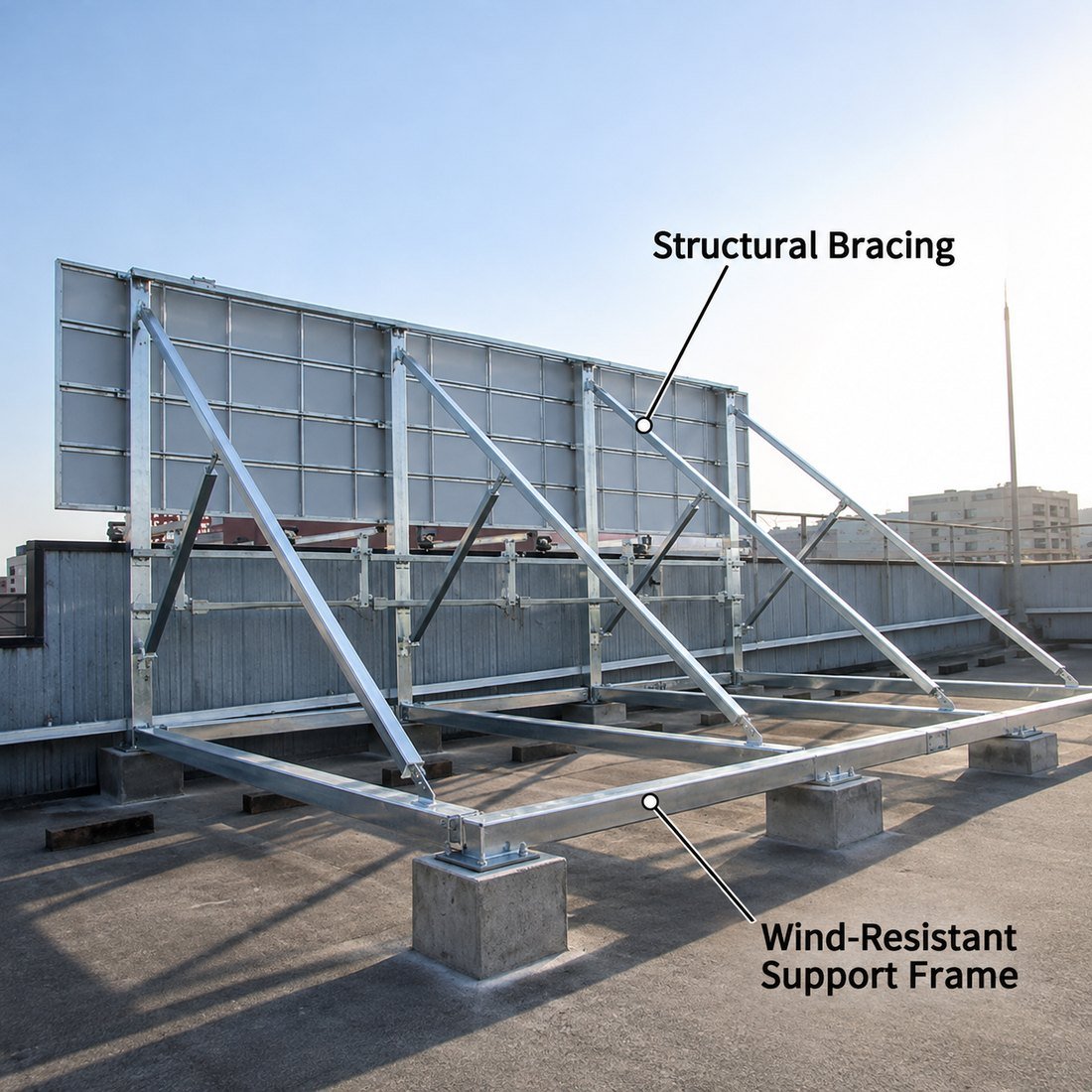
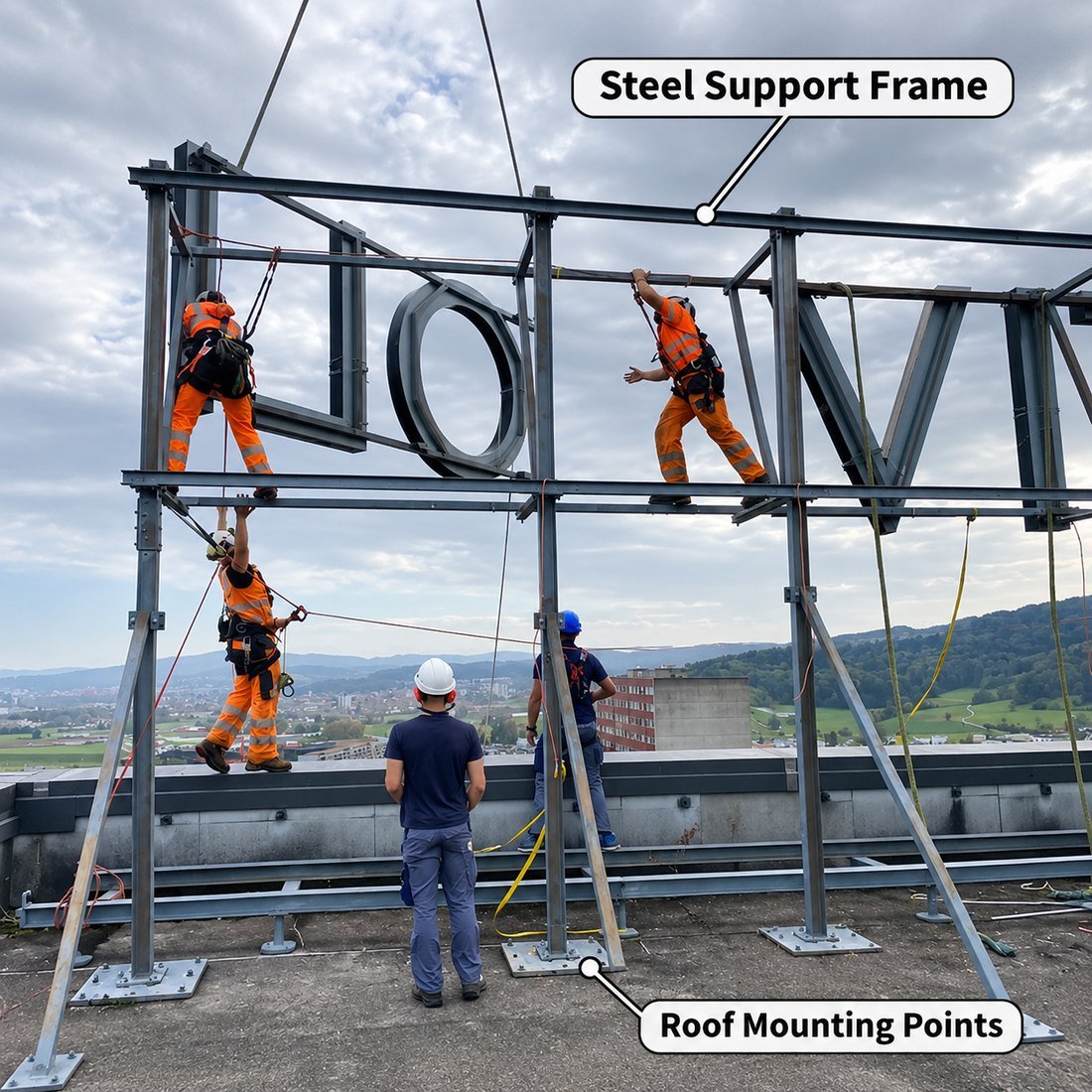
There are two routes. An anchored frame uses base plates and chemical or mechanical anchors into the slab, curb or structural members, with the penetrations flashed and sealed. A non-penetrating ballast frame carries concrete blocks on a steel sled, holding the sign down with weight instead of fixings.
Leased roofs often ban drilling into the deck, which makes ballast the only option — and ballast changes both the structure and the price, because the frame has to be heavier and the roof has to carry that weight. Confirm the roof rules before the design is drawn, not after.
Corrosion Protection
A rooftop sign faces sun, rain, salt and wind year-round with no shelter. The steel and hardware have to resist rust or the structure will fail long before the LEDs do. Hot-dip galvanising and quality coatings are the baseline; coastal air calls for marine-grade protection on the frame and the fasteners.
The marine-grade corrosion protection case study shows what that means on a Caribbean site.
Electrical Safety
An illuminated rooftop sign carries electrical systems fully exposed to weather. Every connection must be sealed and outdoor-rated, and the enclosure has to shed water rather than trap it.
Outdoor LED components usually carry IP65 or better, but a component rating is not the same as whole-fixture protection: a sign is an assembly, and its real protection is set by the weakest joint. A local electrician verifies the wiring, the disconnect and the supply.
The outdoor IP ratings guide explains what each digit actually proves, and the outdoor sign electrical systems guide covers wiring, drivers and weatherproofing.
Permits and Zoning
Rooftop signs face the strictest permit rules in signage. Many cities cap their height and area, and some ban them outright in certain districts or on buildings above a set height. Plan for this early, because it shapes the design rather than following it.
A permit package for a rooftop sign usually needs stamped structural drawings, and often electrical plans and a wind-load report as well. The reviewing authority is checking that the sign will not fail, not that it looks good.
The city is not the only approval. Landlords enforce their own sign criteria — malls and office towers often have a package that controls size, placement, lighting and sometimes the vendor you may use. That review runs separately from the municipal permit, and missing either one stalls the project.
Approval can take weeks or months depending on the jurisdiction and how complete the submission is. A rendering is not a permit, and a factory drawing is not a structural approval — both are inputs to the application.
The commercial property sign approval process walks through the submission sequence and what each reviewer is looking for.
What a Rooftop Sign Costs
Rooftop signs cost more than wall or storefront signs of the same face area, and the gap is structural rather than decorative. Three things drive it: the sign body, the steel that holds it up, and the crane that puts it there.
Size leads. A bigger face needs more material, a heavier frame and a stiffer structure, and the engineering cost scales with all three. Illumination adds modules, drivers and power supplies; access adds rigging, permits and roof protection.
| Rooftop sign | Sign body | Steel structure | Crane + install |
|---|---|---|---|
| Mid-size front-lit letters | $8,000 to $20,000 | $4,000 to $10,000 | $3,000 to $8,000 |
| Large halo-lit letters | $20,000 to $50,000 | $10,000 to $30,000 | $8,000 to $20,000 |
| Digital / LED face | $40,000 to $120,000+ | $20,000 to $60,000 | $15,000 to $40,000 |
Read the first row across: the bottom of each band adds to about $15,000 all in, and the middle of each band lands nearer $26,000. Large engineered structures run well into six figures. Engineering, permits and freight sit outside these figures, and on a rooftop they are not small lines.
Factory-direct pricing removes the reseller margin on the sign itself, but not the site costs. Your installed total still includes freight, duties and local crane and electrical work — which is why two quotes for the same sign can differ by a third before anyone compares the sign at all.
For the underlying factors behind any sign quote, the custom business signs cost guide is the pillar. Running a storefront rather than a tower? The restaurant sign cost guide covers that budget instead.
What Decides Feasibility
Before anyone draws a sign, five facts decide whether the project is possible at all. They are cheap to establish and expensive to discover late.
- Roof height and the height of the sign above the roof — together they set the design wind speed and the crane reach
- What the roof is: membrane, concrete slab, metal deck, or a plant screen you cannot load
- Who owns the building, and whether the lease allows penetrations or requires ballast
- The city, so the applicable sign code and design wind speed can be looked up before design
- Which directions the sign must be read from, since that sets the face count and the letter height
Send roof photos, your city and the roof height and a factory can calculate the rest — face size, structure, wind load and a budget range. That first pass is what turns a rooftop idea into a project with a number attached.
Installation Process
Rooftop installation is a rigging job, not a mounting job. It needs planning, permits, a crane and a crew trained to work at height, and the sequence is fixed.
1. Confirm the structure. The crew verifies the anchor points against the stamped drawings, then installs the steel frame and ties it into the building — or sets and levels the ballast frame.
2. Lift the sign. A crane raises the sign sections to the roof. Sections are lifted rather than the whole assembly wherever the roof or the crane capacity requires it.
3. Secure and align. Each section is fixed to the frame, plumbed and aligned across the full face, so the letters or panels read as one line from a distance.
4. Connect and inspect. The electrical system is connected and tested, and a final inspection confirms the sign is safe, sealed and lit.
Hicen ships rooftop signs with pre-wired assemblies and engineered drawings, which is what makes a local crew’s job predictable. The site survey, crane work, electrical hookup and final inspection stay local — and every powered sign runs a 48-hour continuous aging test before packing, which checks wiring and modules rather than structural or field performance.
The manufacturing process shows where that test sits in production, and the lead time and sampling guide covers the schedule: samples in 3 to 5 working days, standard production 7 to 15 working days after approval, with large engineered structures running longer.
Maintenance and Lifespan
A well-built rooftop sign lasts many years with care. The LED modules usually outlast the driver and the face, so maintenance is mostly about the parts that are not the LEDs.
Have a qualified professional inspect the structure and the fasteners on a schedule. Coastal and storm-prone sites need closer attention: salt attacks fixings first, and a loose fastener on a rooftop frame is a structural question rather than a cosmetic one.
Inspect after severe weather. Look for corrosion at the base plates and welds, loose or missing fasteners, water ingress at the face joints, and any change in the sign’s alignment against the roofline.
Keep the face clean for maximum brightness, and replace a failed LED module promptly — one dark letter on a rooftop is visible from much further away than the module is worth.
The LED signage lifespan guide covers what fails first and how to plan replacement.
Why Choose Hicen for Rooftop Signs
A rooftop sign needs a factory that can handle engineering, fabrication and export in one place. Most sign shops can fabricate; far fewer can produce a frame that a local engineer will stamp and a crate that survives an ocean crossing.
Hicen runs in-house structural engineering for exterior signage, designing for wind, corrosion and local code rather than for a generic load case. The factory supplies turnkey exterior signage from design through production: engineered drawings, fabricated steel and tested electrical in one package.
What stays local is the site work — survey, crane, electrical connection and inspection — which is also where the cost and the schedule risk sit. Knowing which half is whose is the difference between a rooftop project that lands and one that stalls at the permit desk.
The turnkey project solutions page covers the scope when the factory coordinates installation as well as fabrication.
Frequently Asked Questions
What is a rooftop sign?
A rooftop sign is a large sign mounted on top of a building, standing above the roofline on a steel support structure rather than fixed flat to the facade. It gives long-range visibility above street-level clutter, which is why hotels, shopping centres and dealerships use them.
How much does a rooftop sign cost?
A mid-size illuminated rooftop sign typically starts around $15,000 all in, and the middle of each cost band lands nearer $26,000. Large engineered structures run into six figures. Those figures cover the sign body, the steel structure and crane installation; engineering, permits and freight are extra.
Do rooftop signs need special engineering?
Yes. A rooftop sign is a structure that catches wind and carries weight, so it is sized to a wind-load standard such as ASCE 7 by a licensed engineer working from the building drawings. Most projects need stamped drawings for permit approval.
Are rooftop signs hard to permit?
They face the strictest permit rules in signage. Many cities cap rooftop sign height and area, and some prohibit them in certain districts. Landlords also enforce their own criteria separately. Approval can take weeks or months, so start early.
How tall should rooftop sign letters be?
Roughly one inch of letter height for every ten feet of viewing distance. A sign read from 500 feet needs letters about 4 feet tall; at 1,000 feet, about 8 feet. Past roughly 1,500 feet, letter height stops helping and contrast matters more.
How are rooftop signs installed?
As a rigging job. The crew confirms the structure and installs the steel frame, a crane lifts the sign sections to the roof, the sections are secured and aligned, then the electrical system is connected, tested and inspected.
What materials are used for rooftop signs?
The support structure is steel, usually hot-dip galvanised for rust resistance. Faces and letters are aluminium and acrylic. Coastal sites need marine-grade corrosion protection on the frame and fasteners for a reasonable service life.
How long does a rooftop sign last?
A well-built sign is estimated at 8 to 12 years in normal service. The LED modules usually outlast the driver and the face, so maintenance concentrates on power supplies, seals and fasteners — with closer inspection on coastal and storm-prone sites.
Can rooftop signs survive hurricanes?
Yes, when engineered for the site’s actual design wind speed. Category 5 is a storm classification beginning at 157 mph sustained, not a design wind speed, so ask for the stamped design wind speed and the code edition behind it rather than a hurricane label.
How long does it take to produce a rooftop sign?
Standard fabrication runs 7 to 15 working days after design approval, with samples in 3 to 5 working days. Large engineered rooftop structures take longer, and permit timelines are separate and vary by city.
Get Your Rooftop Sign Quoted
Send Your Roof Details for a Feasibility Check
Share roof photos, the building height and your city. You get a face size, a structure recommendation and a budget range, with a factory quote within 24 hours and a free design draft.