A restaurant sign is priced before anyone quotes it: by type, size, lighting, and where it has to be installed. Here are the ranges buyers actually plan with, and the lines that decide which end of them you land on.
Quick Answer: Restaurant Sign Cost Ranges
The table below is the planning grid to start from when you need a budget before you have drawings. It covers fabrication of the sign itself. Installation, permits, electrical work and freight are separate lines, and they are the ones that surprise first-time buyers.
| Sign type | Typical size | Lit or non-lit | Planning range (USD) |
|---|---|---|---|
| Channel letter storefront sign | 8 to 20 ft wide | Lit | $3,000 to $12,000 |
| Cabinet / light box sign | 4 to 12 ft wide | Lit | $1,500 to $5,000 |
| Blade / projecting sign | 2 to 4 ft | Lit or non-lit | $800 to $3,500 |
| LED neon accent sign | 1 to 4 ft | Lit | $200 to $3,000+ |
| Backlit menu board | 3 to 6 ft | Lit | $500 to $2,500 |
| Monument or pylon sign | 4 to 10 ft tall | Lit or non-lit | $5,000 to $15,000+ |
| Awning or canopy sign | 8 to 20 ft wide | Non-lit, or lit valance | $1,500 to $6,000 |
| Window vinyl graphics | Per window | Non-lit | $150 to $800 |
Two notes on reading it. The ranges are wide because they have to be: a ten-letter front-lit set and a fifteen-letter halo-lit set are the same sign type and four times apart in price. And halo-lit or combination-lit channel letters start above the front-lit figure here, because the light has to bounce off the wall behind the letters and that changes the assembly.
Factory-direct pricing from a manufacturer like Hicen often sits below these ranges, because there is no reseller margin inside the quote. For the broader version of this grid across every sign type, the custom business signs cost guide is the pillar; this post is the restaurant-specific companion.
What Drives Restaurant Sign Cost
Six factors move almost every restaurant sign quote. Understand them and you can predict which end of a range you will land on before anyone quotes you.
Size. Bigger signs use more material, more LED modules and more fabrication time. Size is usually the largest single driver, which is why the next section is about the size you actually need rather than the size you want.
Material. Aluminium, stainless steel and acrylic sit at different price tiers, and the finish matters as much as the metal. A painted aluminium letter and a brushed stainless letter with a polished face are the same sign type at very different prices.
Illumination. A lit sign adds modules, drivers, wiring and waterproofing. Front-lit is the standard lit build and the most economical; halo-lit adds standoffs and rear-facing modules; combination-lit, glowing front and back, is the most expensive standard option.
Complexity. Detailed logos, custom shapes, many colours and tight radius corners all add labour. A clean wordmark is cheaper to build than a hand-drawn mark with twelve colours.
Quantity. Fixed setup work — drawing, programming, finishing preparation — spreads across more units on a larger order. A multi-site rollout costs more in total but less per sign.
Installation. Mounting, electrical hookup, access equipment and permits add to the total. Height and wall condition affect this more than most buyers expect.
Size and Letter Height
For a restaurant, size is not a taste decision — it follows from where the sign has to be read. The working rule is roughly one inch of letter height for every ten feet of viewing distance, under good daylight contrast with a reader who is not moving.
| Viewing distance | Minimum letter height | Comfortable letter height |
|---|---|---|
| 10 feet | 1 inch | 1.5 inches |
| 30 feet | 3 inches | 4.5 inches |
| 50 feet | 5 inches | 7.5 inches |
| 100 feet | 10 inches | 15 inches |
| 200 feet | 20 inches | 30 inches |
That table explains a price gap buyers find confusing. A wall sign read from the pavement at 50 feet needs five-inch letters. A pylon read from the road at 200 feet needs twenty-inch letters before you add anything else — four times the letter, more than four times the material, and a structure underneath that a wall sign never needs.
Driving speed, night viewing and weak contrast all push those numbers up. The letter height and viewing distance rules work through the corrections, and the LED signage cost breakdown covers the ten factors behind any illuminated quote.
Cost by Restaurant Sign Type
Different signs do different jobs on the same building. Here is what each one costs, what moves the number, and where it earns its place.
Channel Letter Signs
Channel letters are individually built 3D letters, each with its own LED modules inside a metal return. They are the default premium storefront sign for sit-down restaurants because they read at night from the length of a street, not just from the pavement opposite.
A single-storefront front-lit set runs $3,000 to $12,000. Letter count, letter height, material and lighting type decide where you land in that band.
Halo-lit letters cost more than front-lit because the glow comes off the wall behind them: that needs standoffs, tighter spacing discipline and a clean mounting surface. Combination-lit sits above both.
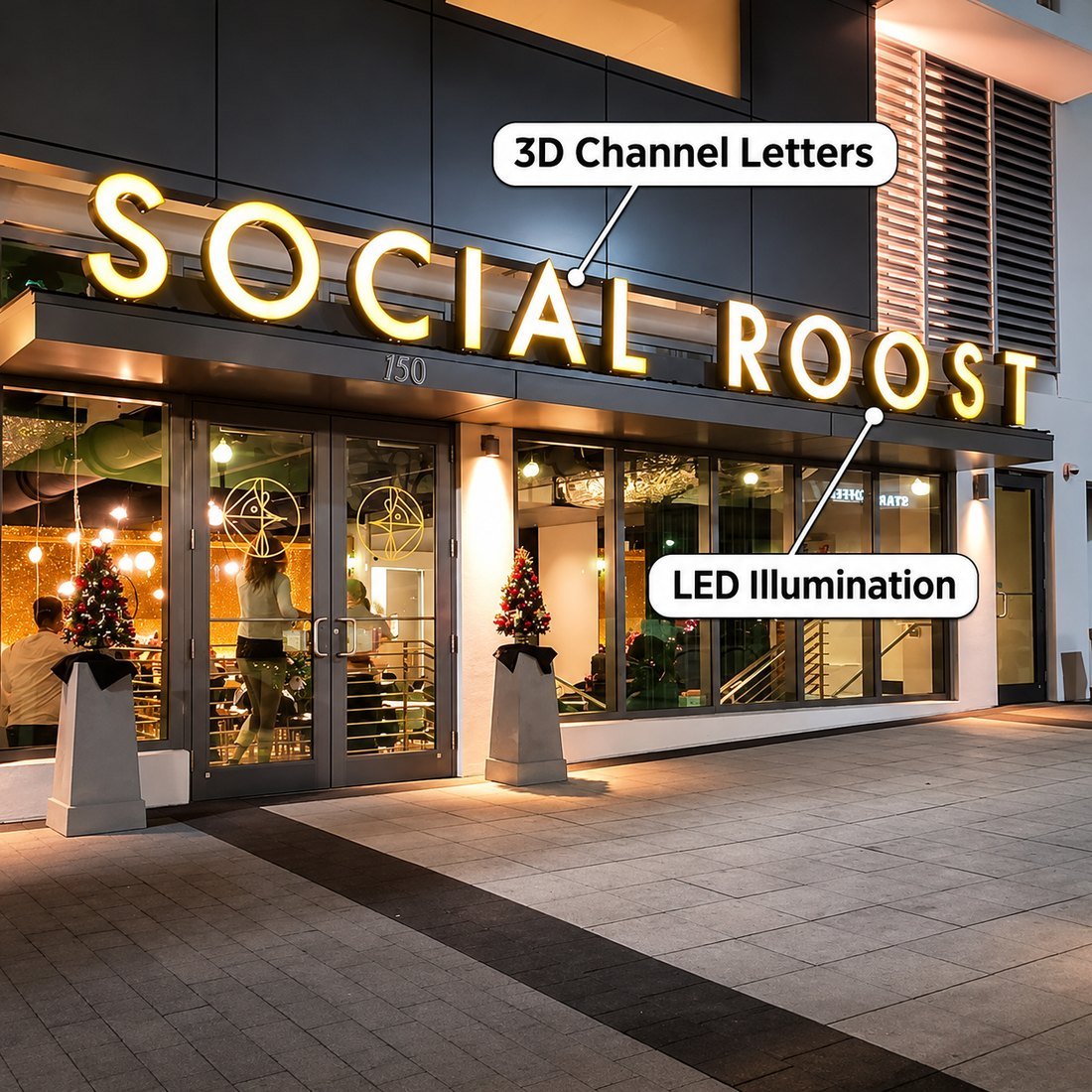
The channel letter range covers build options, and the channel letters versus cabinet signs comparison is worth reading before you commit to either.
Cabinet and Light Box Signs
A cabinet sign is a single lit box with a printed face. It carries a full-colour logo, a menu or a graphic across one panel, and it covers a large wall area for less than channel letters do over the same area.
Expect $1,500 to $5,000 for a storefront-size cabinet. Restaurants with graphic-heavy brands, franchise prototype requirements or a menu posted outside usually get more from a cabinet than from letters, because the whole face can be artwork rather than just the name.
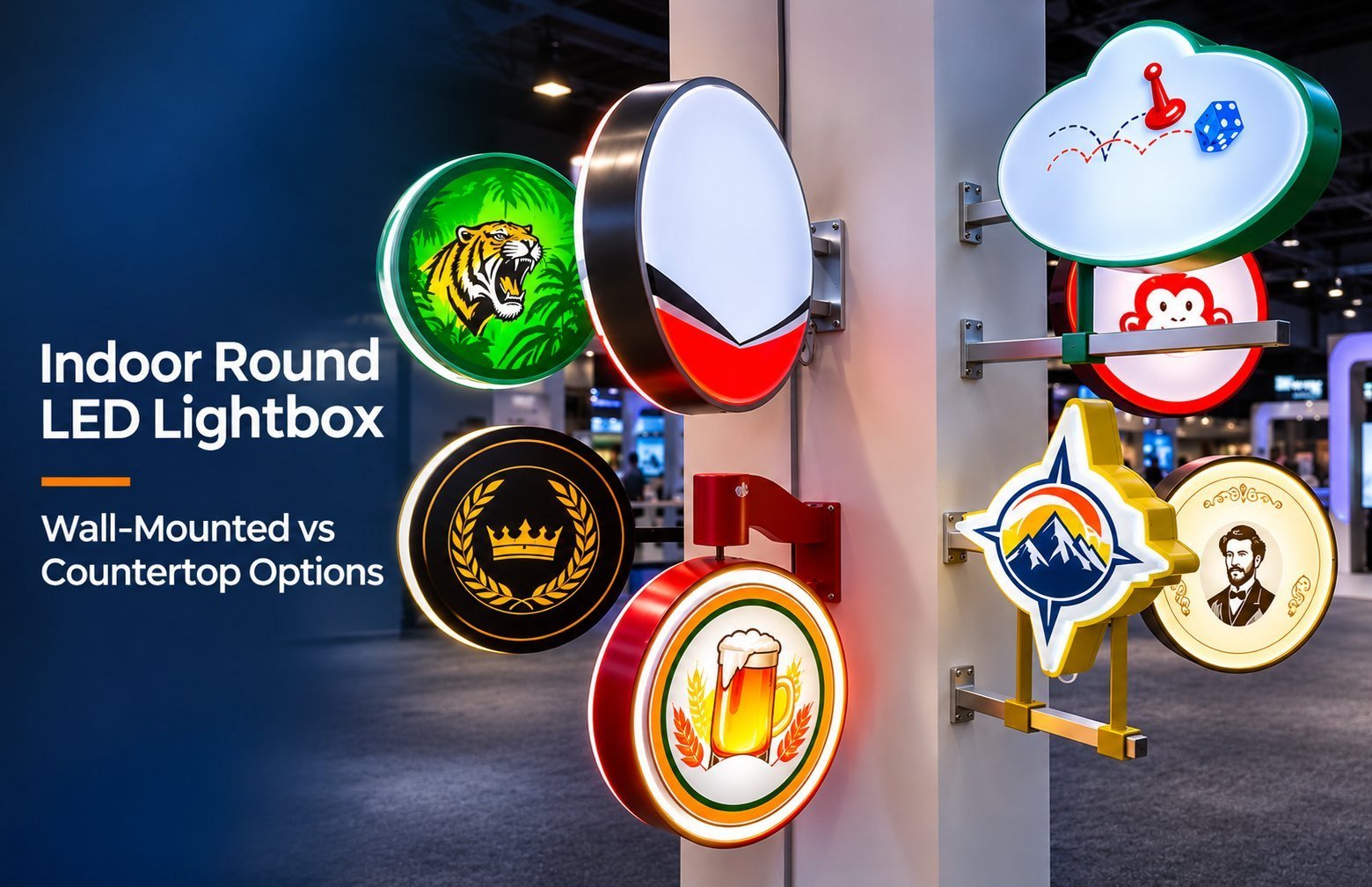
Frameless and standard builds are both covered on the LED light box line.
Blade and Projecting Signs
A blade sign projects perpendicular to the wall, so it is read by people walking along the frontage rather than across the street. On a parade of shops or a narrow lane, it is often the sign that actually gets noticed.
These run $800 to $3,500 depending on size, whether they are lit, and how the bracket is fixed.
The wall decides a lot of that. Brick, render and glazed tile need different anchors, and a heavy double-sided blade may need a spreader plate or through-bolts rather than resin anchors. A bracket that looks decorative in a drawing is a structural decision on site.
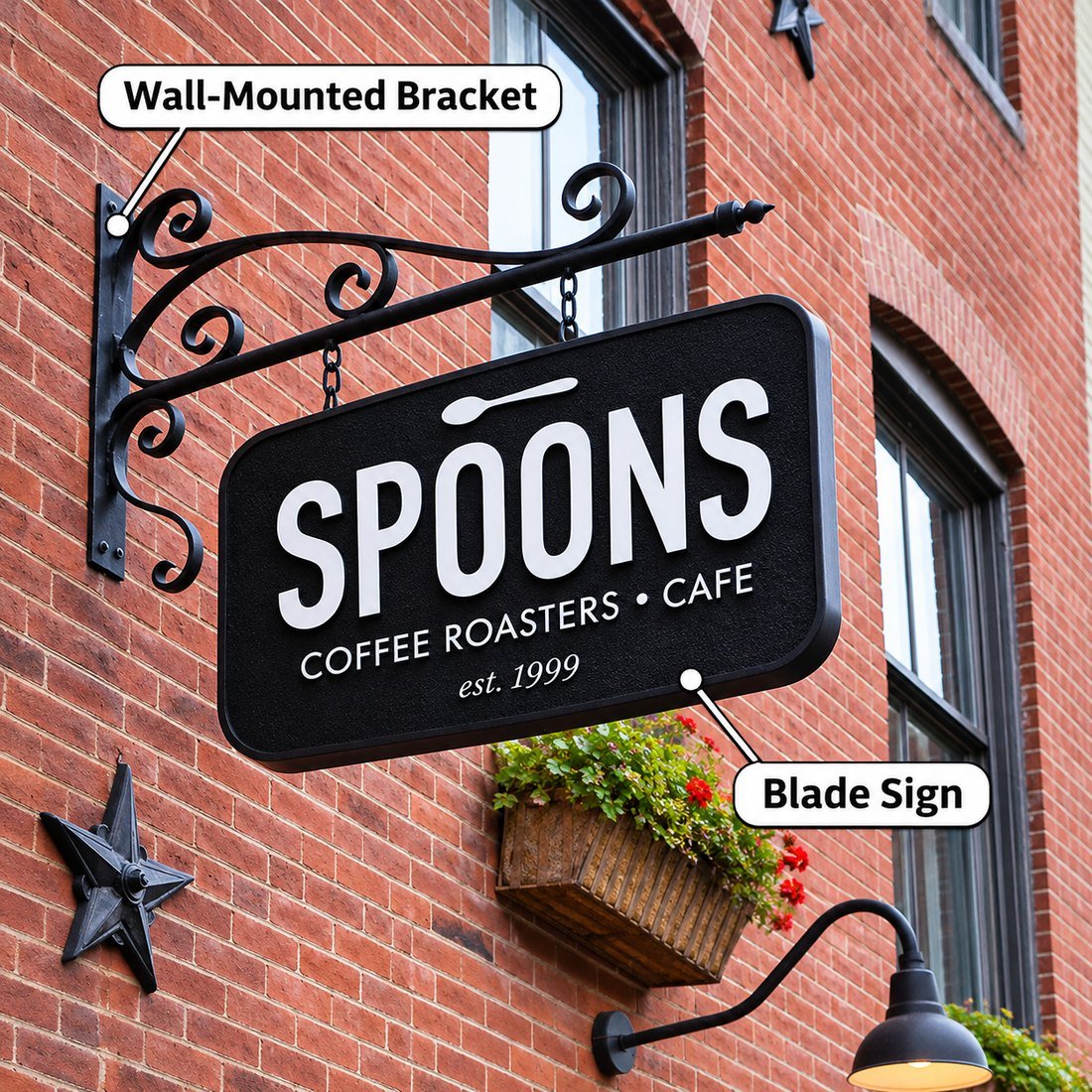
Blade signs also have to clear head height over a pavement, which caps how low the panel can hang and therefore how large it can be without looking squeezed.
LED Neon Signs
LED flex neon is the interior sign most restaurants add after the exterior is finished. It is a slogan, a logo outline, a bar back or a photo wall, and it does the marketing itself because guests photograph it.
Indoor pieces start around $200 to $300 for a short single-colour word and run to $3,000 or more for a long, multi-colour design with dimming. Length, complexity, colour count and whether the piece needs an outdoor rating set the price.
The custom neon sign options cover words, icons and full logo outlines, including outdoor-rated builds.
Menu Boards
A backlit menu board is a sales tool before it is a sign. Orders move faster when the menu is legible from the queue, and mistakes drop when modifiers and prices are unambiguous.
Backlit panels run $500 to $2,500. Size and panel count drive it, so a three-panel drive-thru set and a single counter board are different projects. Digital boards cost more to buy and more to run, but they change a price without a reprint.
Awning and Canopy Signs
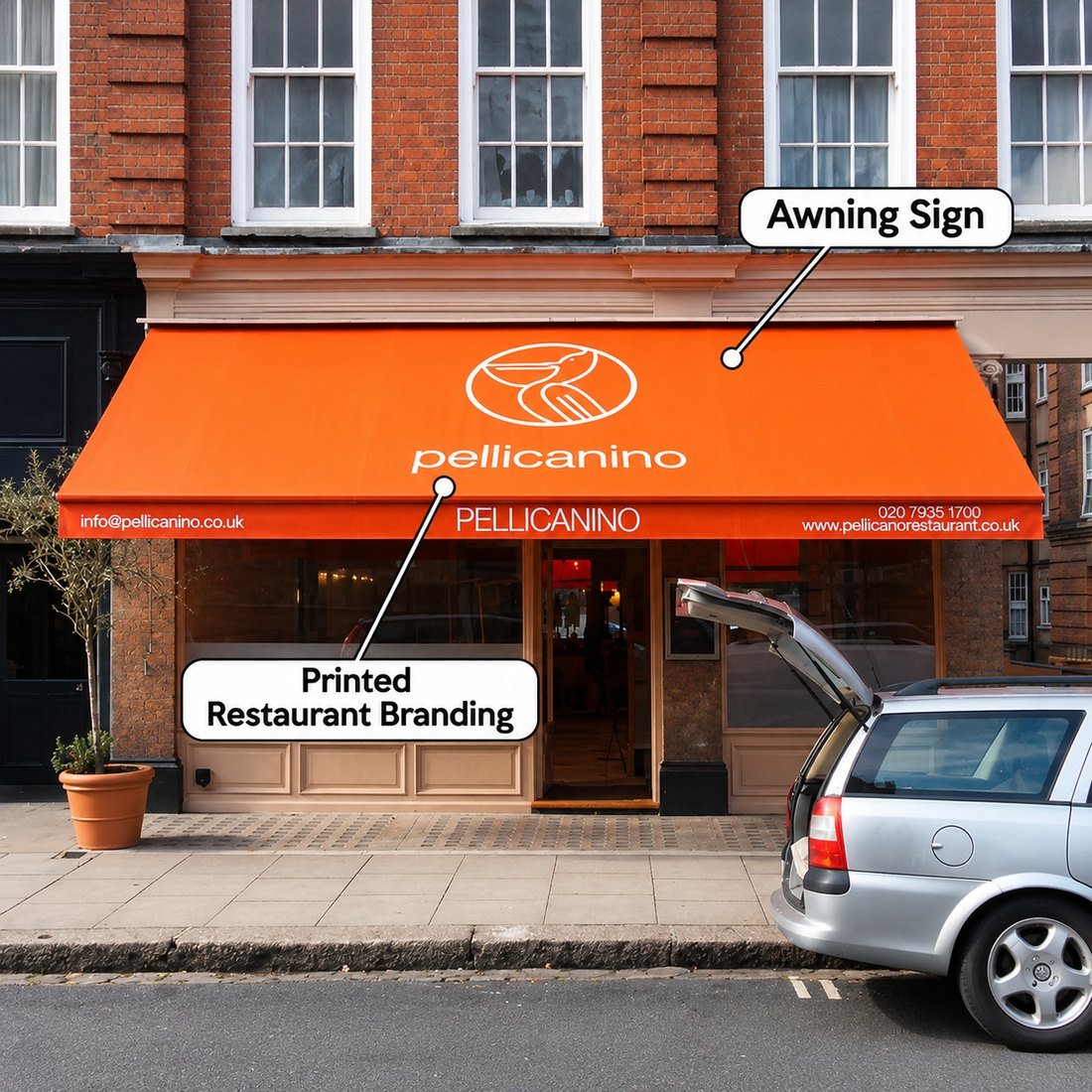
An awning does two jobs: it shades the frontage and it carries the name. On a south-facing unit it also protects window graphics from UV, which is what makes printed vinyl last through more than one summer.
This is the line item that gets quoted case by case, because the canopy usually costs more than the branding on it. A new fixed frame with printed fabric is a different project from re-covering an existing frame.
The printed valance and logo are a small fraction of either. If the frame is sound, re-branding the awning is one of the cheapest ways to change how a frontage reads.
Monument and Pylon Signs
Monument signs sit at ground level on their own base. Pylons raise the panels on a mast so they clear cars, planting and the rest of the streetscape. For a restaurant set back from the road, one of the two is usually the difference between being found and being passed.
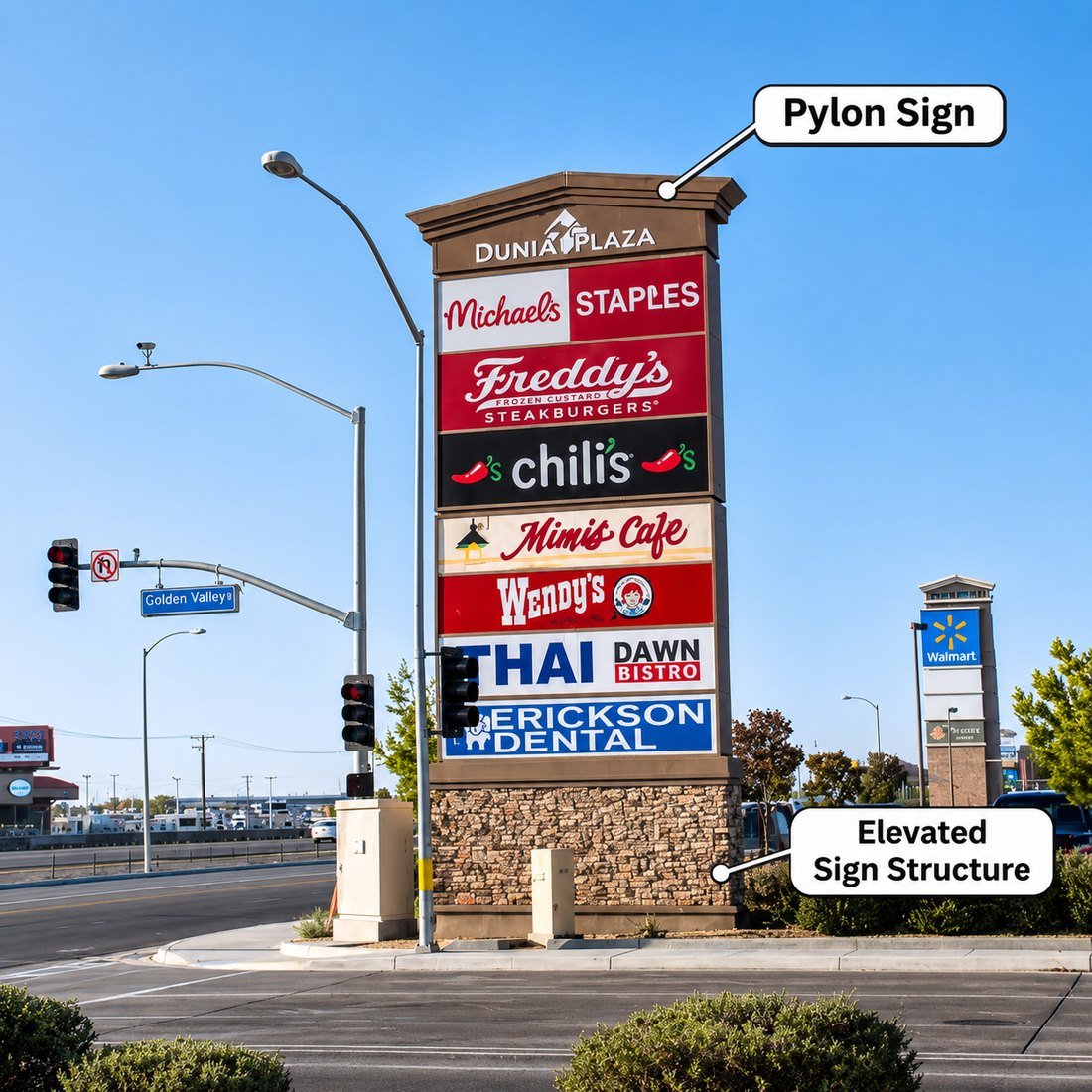
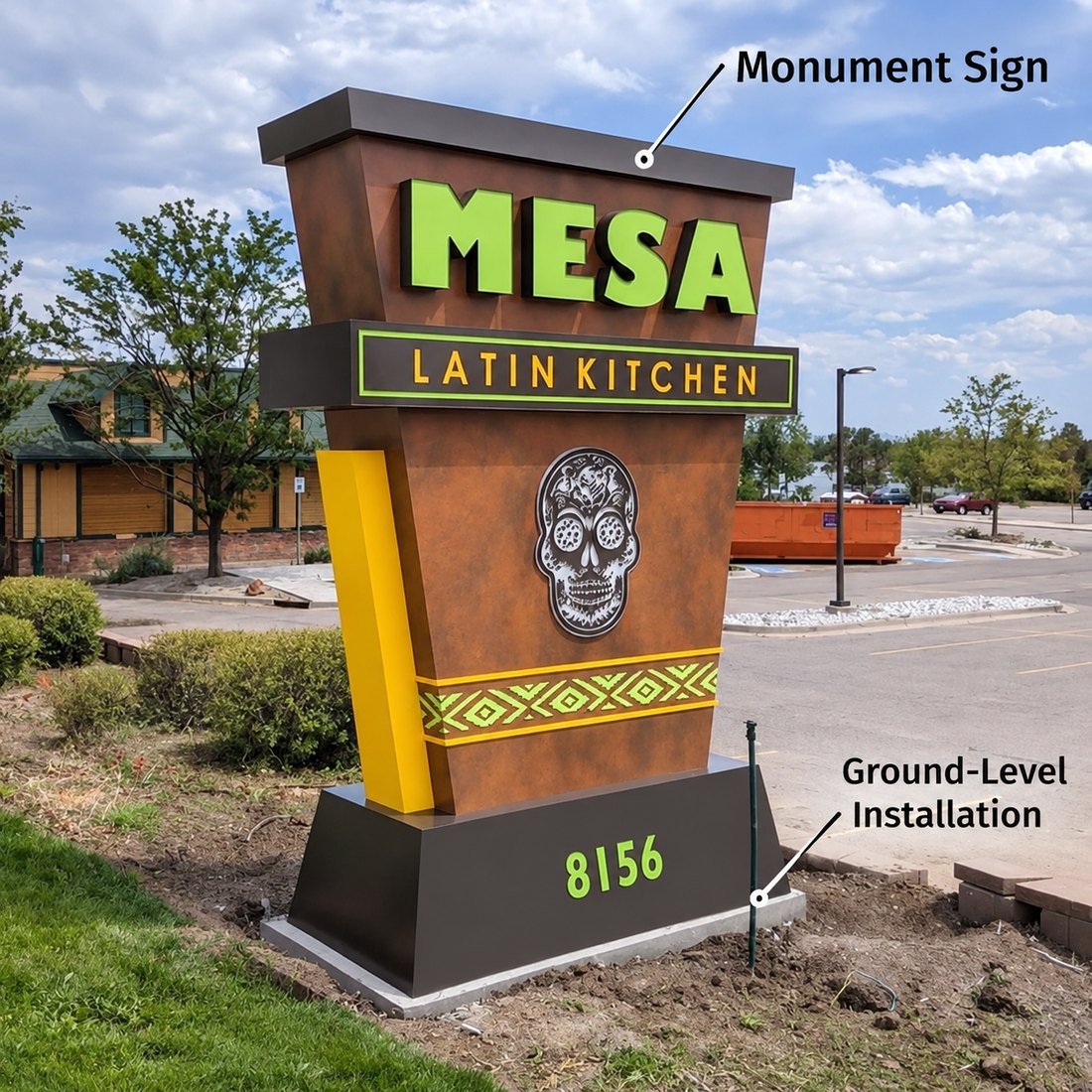
A full structure runs $5,000 to $15,000 or more. Digital-face and double-sided builds go well past that — $25,000 and up is normal once a digital face, engineering and a foundation are included. These are the signs where engineering, permits and site access are not optional extras.
For the digital variant, the double-sided digital pylon design guide covers the structural and display decisions. The restaurant signs range lists the formats we manufacture for restaurant projects.
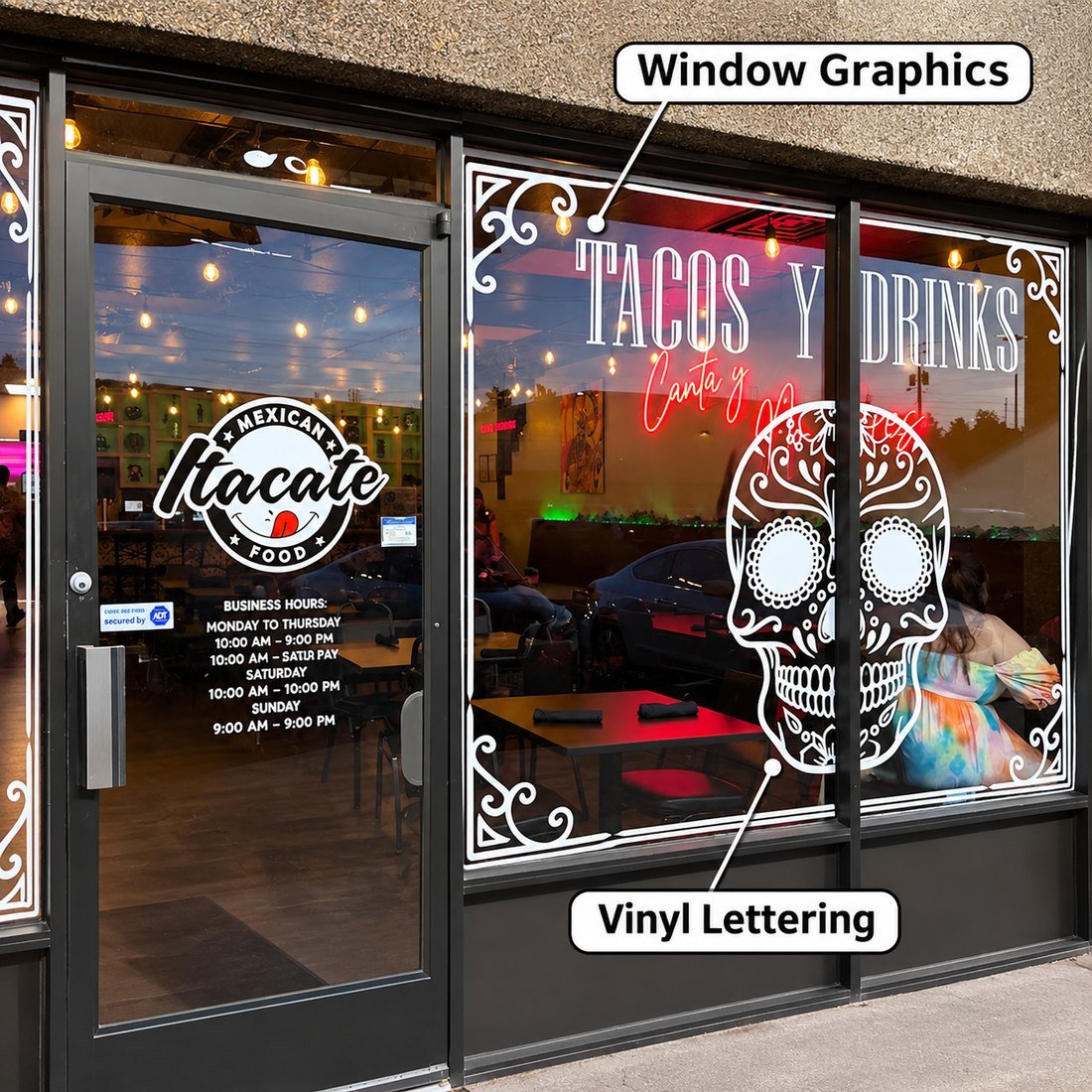
Window Graphics and Vinyl Lettering
Window vinyl is the cheapest way to put the offer on the glass: hours, delivery, a seasonal menu, or a frosted band that stops the room being stared into from the pavement.
Cut vinyl and printed graphics run $150 to $800 per window. Coverage, perforated versus solid film, and how much weeding a detailed logo needs are what move it.
Three lines of opening hours on a door is a small job. A full storefront wrap across four panes is not, and it needs the glass measured pane by pane rather than as one opening.
How Restaurant Type Changes the Budget
The same budget buys different signage depending on what kind of restaurant it is. This is the part a generic sign price guide cannot answer.
Quick-service and fast casual. The money goes outside and to the counter: a pylon or pole sign that works from the road, a lit menu board, and window graphics for the offer. Interior neon is optional; a legible drive-thru or collection point is not.
Full-service and fine dining. The storefront carries the brand, so channel letters or a premium cabinet take the largest share, with a blade sign for the pavement and restrained interior signage. Halo-lit letters and dark backgrounds photograph better and cost more.
Cafés and bakeries. An awning plus window graphics usually does more than a large illuminated sign, because the frontage is short and the trade is on foot. A small neon piece inside covers the interior for a few hundred dollars.
Bars and late-night venues. Contrast matters more than size: a dark frontage needs a lit blade sign and a bright window or door treatment, and interior neon does double duty as decoration and as the photograph guests post.
Outdoor vs Indoor Budget Split
First-time buyers tend to spend the whole budget on one sign. The frontages that read best carry a cluster: one primary sign that holds the brand at distance, one that catches the pavement, and interior pieces that carry the offer.
| Line | Illustrative amount (USD) |
|---|---|
| Front-lit channel letters, 10 letters, 12 ft | $6,000 |
| Blade sign, double-sided, non-lit | $1,200 |
| Window graphics, three windows and a door | $900 |
| Backlit menu board, two panels | $1,400 |
| Interior LED neon, single word | $600 |
| Sign subtotal | $10,100 |
| Permit, installation and electrical allowance | $2,400 |
| Total | $12,500 |
Those numbers are illustrative, built from the ranges above for a 60-seat restaurant with a 12-foot frontage. Your split will move with the site: a corner unit with two elevations needs more sign than a mid-terrace one, and a listed building may need less than the code allows.
The order matters more than the amounts. Exterior first, because it is the sign that has to pass approval and be installed before you can trade. Interior second, because it can be added after opening without anyone noticing it arrived late.
Factory-Direct vs Local Sign Shop
Where you buy changes the price as much as what you buy. A local sign shop that does not fabricate is a project manager: it takes your brief, orders from a factory, marks the price up to cover design time, site visits and margin, and arranges installation.
Factory-direct removes that layer. You deal with the people who cut the letters, which is also why specification questions get answered in engineering terms instead of sales ones.
The trade-off is coordination. You own freight, customs if you are importing, and hiring a local installer for the mounting and electrical work. Compare quotes on a landed, installed basis — sign price plus freight plus duties plus installation — rather than on the sign price alone, or the two numbers will not be comparable.
The buyer’s checklist for sourcing custom signs covers the paperwork side, and turnkey project solutions is the route when you would rather the factory coordinated installation too.
Hidden Costs to Plan For
The sign price is the part everyone budgets for. These are the lines that arrive afterwards, and they are a normal part of the project rather than a surprise to argue about.
| Cost line | Typical US allowance | What sets it |
|---|---|---|
| Sign permit and drawings | $100 to $1,500 | City fee schedule, sign area, whether drawings must be stamped |
| Installation labour | $500 to $3,000 | Height, wall condition, access equipment, single or double face |
| Electrical connection | $300 to $1,500 | Distance to the panel, whether a circuit is already there |
| Engineered drawings | $500 to $2,500 | Structural signs, wind load, foundation design |
| Freight | Quoted per shipment | Volumetric weight of the crate, destination, trade term |
| Duties and taxes | Varies by country | Declared value, country of origin, tariff classification |
Treat every figure as an allowance, not a rate. Permit fees are set by your city, installation by your wall, and freight by the volume of the crate rather than the weight of the sign — a light sign in a big box costs more to ship than a heavy one in a tight box.
Electrical scope is where imported projects most often stall. The outdoor sign electrical systems guide covers what the installer needs to have on site before the sign arrives.
Permits, Landlords and Sign Codes
Two approvals can stop a sign that has already been built: the city and the landlord. Both want drawings, and they do not want the same drawings.
Sign codes cap area, height and projection, and often illumination as well. A shopping centre can prohibit internally lit cabinets on a heritage frontage even where the city would allow them, and a landlord’s design criteria are frequently stricter than the code.
Get the approval path in writing before fabrication. A rendering is not a permit, and a factory drawing is not a structural approval — they are inputs to the application, not substitutes for it.
The commercial property sign approval process walks through the submission sequence and what each reviewer is looking for.
Lead Time and What to Expect
Price is only half the planning. Timeline decides whether the sign is up for opening night.
Standard production runs 7 to 15 working days after you approve the design and sample. Samples are typically ready in 3 to 5 working days, and simple builds can move faster. Rush production is possible, but it compresses the schedule, never the testing.
Every powered sign runs a 48-hour continuous aging test before it ships. That is where early LED, driver and flicker faults surface — on the factory floor rather than on your wall in the first week of trading.
Then add freight and installation. A fit-out that leaves signage to the last fortnight is the most common reason a restaurant opens with a temporary banner over the door.
The MOQ, lead time and sampling guide breaks the schedule down stage by stage, including the four kinds of sample and when each one is worth the time.
How to Get an Accurate Quote
A range is a planning tool. A quote is a price, and the difference is how much the factory knows about your site. Six items get you from one to the other in a single exchange.
- Your logo as a vector file — AI, EPS, PDF or SVG — not a screenshot or a JPEG
- Sign dimensions, or the maximum width and height the frontage allows
- Storefront photos taken straight on, plus one from each side
- The mounting surface: brick, render, tile, timber, metal cladding or a freestanding base
- Which signs are illuminated, and whether power is already at each location
- Quantity, target installation date, and any landlord or brand-standard drawing
Hicen quotes within 24 hours and sends a free design draft within 1 to 2 hours of a straightforward logo. Those two steps are what turn a range into a number you can compare line by line against a local shop’s quote.
If your artwork is not ready, the artwork and logo file guide explains what a factory needs and why a low-resolution file costs more to fix than to redraw. For design direction first, the restaurant sign ideas guide covers what works by format and setting.
Five Ways Restaurants Overspend on Signage
Most overspend on restaurant signage is not a pricing problem. It is a specification problem, and it repeats across projects.
1. Letters sized for the wrong distance. Twenty-inch letters on a frontage read from 30 feet cost roughly four times what five-inch letters do and look worse on the wall. Size to the viewing distance, then to the code.
2. Lighting every sign. A lit sign needs modules, drivers, a power connection and waterproofing. On a unit that trades daytime only, an unlit sign at a third of the price can be the right answer.
3. Buying the interior before the exterior is approved. Interior neon is cheap and quick, so it gets ordered first. Then the storefront sign hits a planning condition and the budget is already spent on the part guests see last.
4. Paying for the design twice. A shop that redraws your logo before quoting is charging for it somewhere. Send vector artwork and a dimensioned brief, and the first quote is closer to the final one.
5. One oversized sign instead of a cluster. A single enormous panel usually costs more than three well-placed signs and does less work, because it has to be read from everywhere and therefore reads well from nowhere in particular.
Frequently Asked Questions
How much does a restaurant sign cost?
It depends on the type. In the US market a front-lit channel letter storefront set runs $3,000 to $12,000, a cabinet or light box sign $1,500 to $5,000, a blade sign $800 to $3,500, and interior LED neon from about $200. Monument and pylon structures start around $5,000 and reach $15,000 or more. These are fabrication ranges, not quotes, and installation, permits and electrical work sit on top.
What is the cheapest restaurant sign option?
Window vinyl graphics and small indoor neon pieces. Vinyl starts around $150 per window and a short single-colour neon word around $200. Both change how a frontage reads for a fraction of a lit sign, which is why they are the usual first purchase for a new restaurant.
What hidden costs come with a restaurant sign?
Permits and drawings, installation labour, electrical connection, engineered drawings where the sign is structural, freight, and duties if you import. As US allowances, permits run $100 to $1,500, installation $500 to $3,000 and electrical $300 to $1,500. Freight is quoted by the volumetric weight of the crate, so packaging design affects it.
How much should I budget for a full restaurant sign package?
A 60-seat restaurant with a 12-foot frontage typically lands around $12,000 to $13,000 for a complete package: front-lit channel letters, a blade sign, window graphics, a backlit menu board, a small interior neon piece, plus a permit and installation allowance. Exterior signage should take the largest share, because it is the part that must pass approval and be installed before you can trade.
Do restaurant signs need a permit?
Most cities require a sign permit for outdoor and illuminated signs, and many require drawings to be submitted with the application. Landlords and shopping centres usually add their own design review on top. Confirm both before fabrication — a rendering is not a permit, and a factory drawing is not a structural approval.
How long do LED restaurant signs last?
A well-built LED sign is estimated at 8 to 12 years in normal service. Module datasheets commonly rate LEDs at 50,000 hours to L70, which is a brightness rating rather than a service-life guarantee: the power supply, the face material and the seal usually need attention before the LEDs themselves fail.
Why is a channel letter set so much more than a cabinet sign?
Channel letters are priced per letter because each one is fabricated, wired and mounted separately. A cabinet is priced per cabinet or per square foot because it is one unit. Over the same wall area a cabinet is usually cheaper, but letters give a dimensional look that a flat face cannot match, which is why sit-down restaurants keep choosing them.
Can I put my logo on an awning I already own?
Yes, if the frame and fabric are sound. Re-branding an existing awning is usually the cheapest way to change a frontage, because the printed valance and logo are a small part of what a new canopy costs. If the fabric is near the end of its life, replacing the cover and printing it in one pass is the better value.
How long does a custom restaurant sign take?
Standard production runs 7 to 15 working days after design and sample approval, and samples are typically ready in 3 to 5 working days. Powered signs then run a 48-hour aging test before shipping. Add freight and installation on top, so a realistic plan is five to eight weeks from brief to a sign on the wall.
Do I need different signs for a drive-thru?
Yes. A drive-thru needs a menu board legible from the lane, a directional or lane sign, and usually a pylon or pole sign that works at road speed. Those are separate line items from the storefront, and they are the ones that decide whether cars find the entrance or circle the building.
Get Your Restaurant Signs Quoted
Send Your Sign List for a Restaurant Quote
Share your frontage photos, dimensions and the sign types you need. You get a factory quote within 24 hours and a free design draft, priced line by line so you can compare it against a local shop.